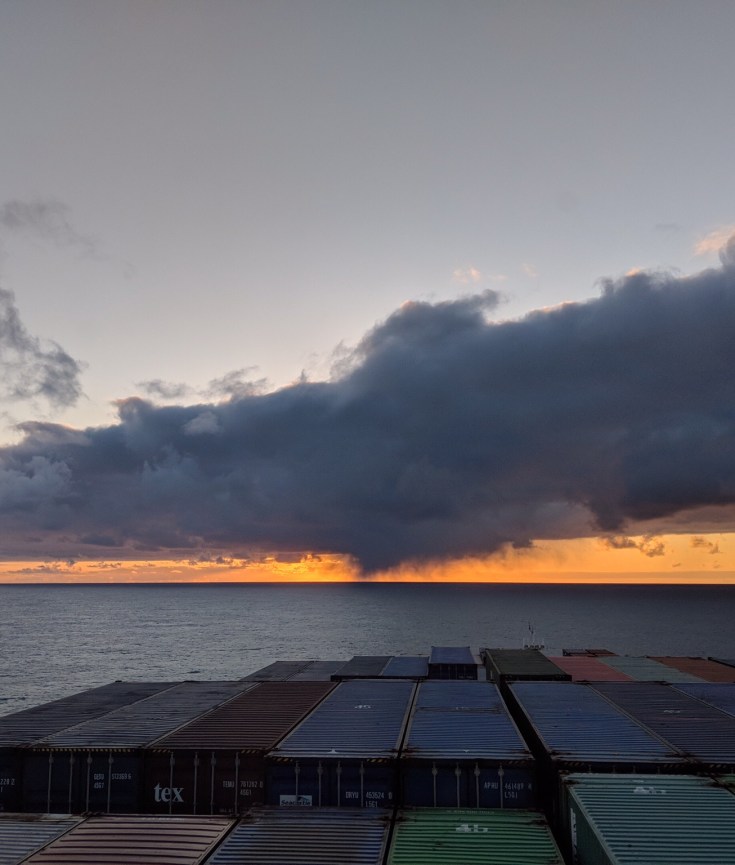

Every morning and evening for three weeks, I’d climb up to the ship’s bridge for a “ramble” — aka pacing back and forth while regarding the unendingly flat horizon. It was beautiful in the way ocean vistas always are and vast in a way the view from the beach can’t quite match.
Every day I’d also look aft, however: toward the massive engine chugging away, where a thick plume of matted brown smoke invariably scarred the sky. Sometimes we’d have a tailwind, and said plume would blow toward the bridge deck, keeping me indoors for days.
This is an apt week to write about ships and emissions, it turns out. The International Maritime Organisation is meeting right now in London to hash out the shipping industry’s coordinated approach to reducing greenhouse gas emissions… and things aren’t looking great. European and Pacific island nations are pushing for binding targets that would put the industry in line with Paris Climate Agreement goals, while some big commodity exporting countries like Brazil and Saudi Arabia are angling for a weak “compromise” deal. (They want to reduce emissions to one half of peak 2008 levels; it’s estimated that the industry would need to cut emissions by at least 70% below 2008 levels to help meet Paris Agreement targets — the Paris Agreement itself being a woefully insufficient compromise, of course.) Team weak sauce seems to have gained the upper hand, just in time for this Friday’s deadline.
After spending 24 days traversing the Pacific Ocean on a massive container ship, the sheer scale of this industry, the challenge of decarbonizing it, and the importance of doing so have just been vividly underscored for me. I chose to ride a cargo ship across the ocean in part due to carbon/climate concerns — and yet I basically just spent the past three plus weeks embedded in one of the world’s most carbon-intensive economic endeavors. This mode of “slow travel” is still arguably greener than flying, but it’s not actually climate-friendly or clean. Not yet.
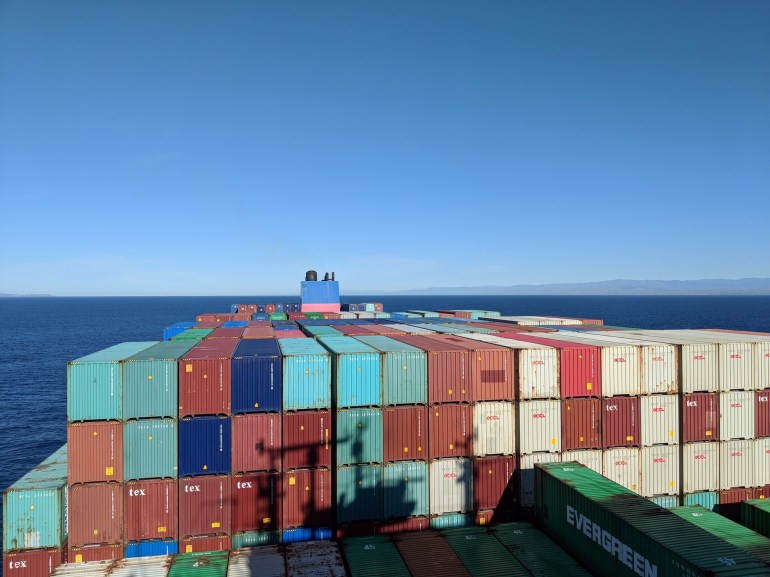
What was riding a cargo ship actually like?
When my cab dropped me off at the Port of Oakland last month, I found myself staring at a very large, somewhat forbidding, not, shall we say, very public-facing gate and wondering what in the world I was getting into. It was 4:00 am, and I was pretty sure the guy who’d given me the address and texted me about the many changes to our departure schedule had gone to sleep. The only people about were longshoremen coming out of the gate after what looked to be a long, messy shift, and looking at me — with my clean clothes and huge backpack and inquiring, lost-puppy smile — like I was some kind of alien. Eventually I found the right intercom button to push, and after another long interval was let in and directed to a van which was to take me to the boat (you can’t just walk, both because the port is big and because it is dangerous). The van driver was very confused about me too. “I didn’t even know you could be a passenger on one of these ships,” he mused.
Before long, he let me off next to the massive black flank of the APL Temasek, where I dodged through a couple of lanes of busy eighteen-wheelers and climbed up a very rickety-feeling gangway. After checking in with the crewman on watch at the top of it, I climbed up another mountain of stairs (that, honestly, had more in common with ladders than with your average staircase) into the “Accommodation” — the narrow white eight-story-apartment-building-on-a-ship that would be my home for the next three weeks (and would even, despite its metallic beige hallways, low ceilings, and relative dearth of natural light, end up seeming sort of homey by the end of the trip).
As a passenger, I wasn’t the profit center — I was incidental. My classification in ship’s documents, where my rank would have been if I’d actually been part of the crew, was “Supranumerary.” I was literally extra. In many ways, people weren’t really sure what to do with me.
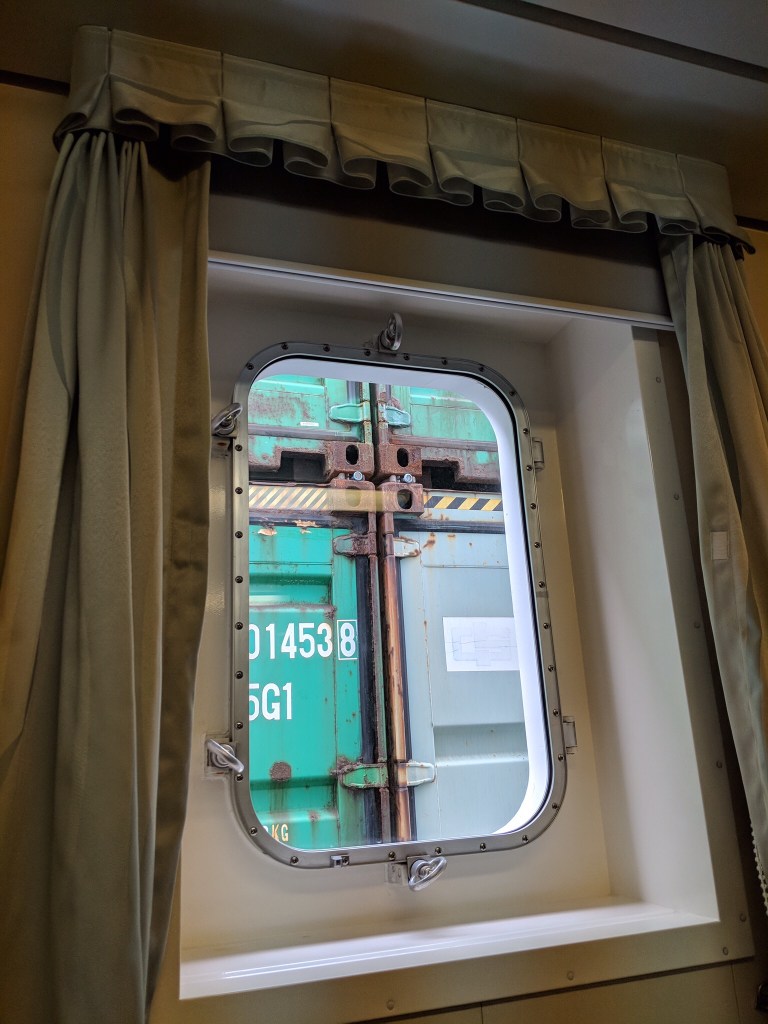
They figured it out though, by and large. This wasn’t a cruise, but neither was it uncomfortable. My cabin was massive, complete with an executive desk, an en suite restroom, a coffee maker, a mini-fridge, four windows looking out at a wall of containers three feet away, and, randomly, one of my favorite books sitting all by its lonesome on a shelf.
Every day, I did yoga in my room, ate an early breakfast, meandered up to the bridge to check out the (largely unchanging) view, did a little meditation, headed back downstairs for lunch at precisely 11:30, maybe did some post-lunch reading, worked out in the small gym (weight machine, stationary bike, broken treadmill) in the afternoon, showered before dinner, ate dinner in the officer’s mess room, headed back upstairs to watch the sunset from the bridge and maybe do a little more meditation, and then watched some of my nearly 100 hours of torrented Star Trek TNG before bed. It’s amazing how quickly and thoroughly one falls into a routine given essentially zero obligations but one (mealtimes).
The food was good, if a bit meat-heavy (and overall heavy) for my tastes. The crew was Filipino, as was the cook, so it was Filipino food most of the time. The ubiquitous fish soup wasn’t as good as my Grandma’s, but it was solidly alright. I’m not a vegetarian, but I eat relatively little meat at home and try to avoid beef and pork. There were almost always chicken or fish options, and often there was a dal to please the Captain, who was Malaysian of Indian descent. Once, to my delight, there was tofu. I ate at the passenger table in the officer’s mess — a little sadly, since I was the only passenger. Sometimes I’d get to chat with one of the officers or engineers at the table next to mine, but often I ate alone.
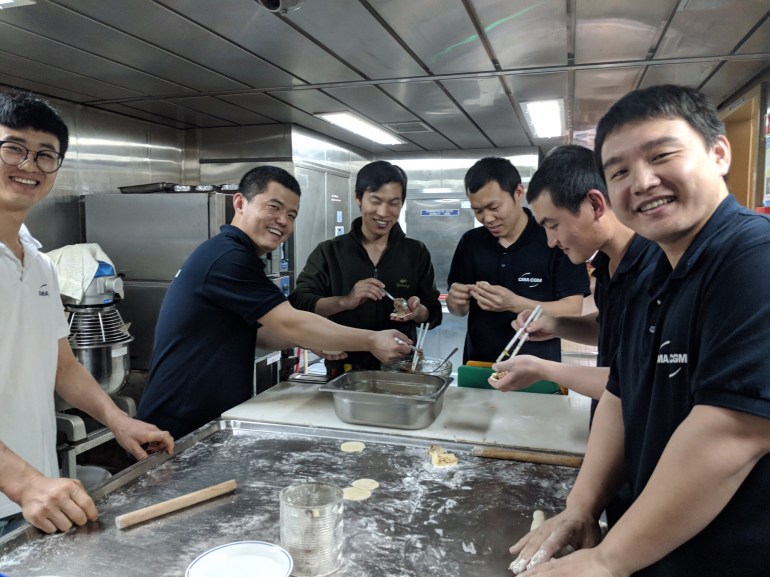
On Saturdays there was usually something special for dinner, like a self-serve barbecue out on the frigid, mostly-enclosed basketball court, or hot pot with dumplings made by the Chinese officers (with a little help by yours truly). Afterwards, there would be a round or two of bingo with cash prizes. That was good fun, and my biggest opportunity to interact with my shipmates, since, well, they had jobs to do most of the time. I won a total of $20 in three weeks, which is not a bad showing, IMO.

About two weeks into the journey, I came down with a stomach bug. Being sick while alone and away from home is invariably terrible, but being sick in the middle of the northern Pacific Ocean during a heavy rolling swell is… not recommended. I never got particularly seasick on this trip, but I do think the sea had a hand in making those two days so viciously miserable. (The greater part of the blame probably belongs to the possibly-not-fully-cooked bbq oysters from the Saturday before, however.)
I had the run of the Accommodation throughout the trip, including the bridge, where there was an officer on watch 24/7. I’d often chat with whoever was up there about where we were in the ocean or how they liked their job or the dizzying array of instruments — radar, chart plotter, radios, etc — that was the bridge’s centerpiece. They’d answer my questions tirelessly, and sometimes point out things like birds or other boats. Once, we had to swerve to miss a pair of whales. For something with so much mass, the ship steered nimbly.
Another time, a small black and white bird knocked itself out against the bridge’s huge forward facing bank of windows, and the officer on watch spent quite a while sprinkling it with water and trying to set it back on its feet. (I think he was ultimately unsuccessful, alas. The bird had succumbed to something predatory, probably a gull, by the next morning.) The presence of birds for the majority of the trip was a marvel to me, as we were several hundred miles south of the Aleutians for most of the middle section of the journey. (I did hear that sometimes birds will alight on the ships, and then get too far out to make it back to land and end up starving.)
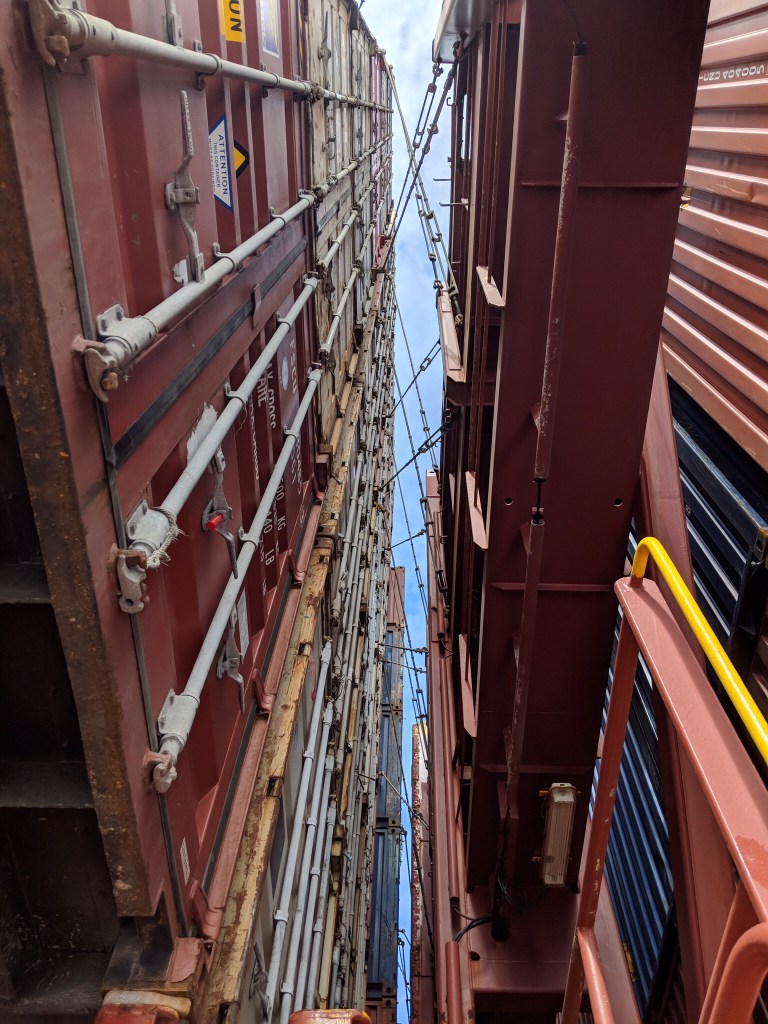
Once, the Chief Officer — who seemed to have more jobs than anybody on board — took me on a tour of the rest of the ship. On the main deck, a walkway runs the length of the vessel, nestled under the outermost row of containers. That was probably the closest I got to the water, and it was still a good three stories down. The railing situation was robust, but it was very hard not to think about the fact that falling off a ship like that in the middle of the ocean almost certainly means dying of hypothermia before any sort of rescue can be mounted.
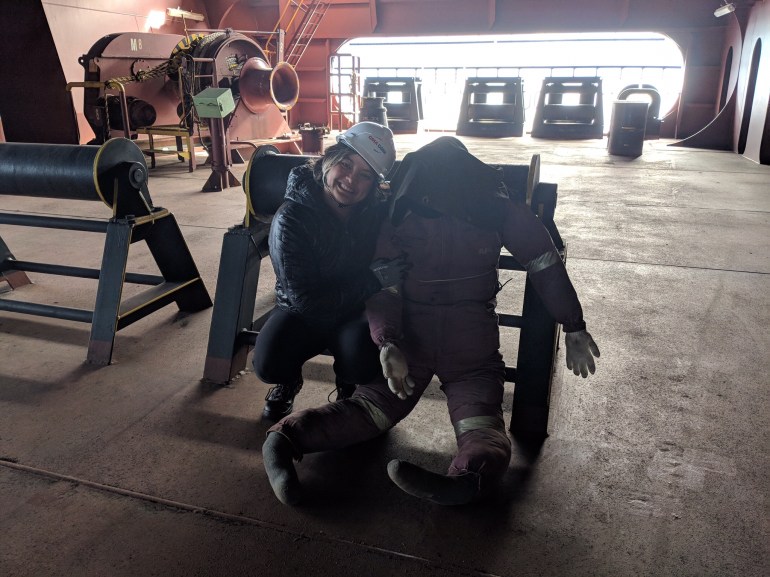
The main deck walkway (and likewise a mirroring one directly below it inside the hull, for getting around in foul weather) leads forward to the bow — which is an open area full of massive winches and anchor chains as big around as my torso — and aft to the stern mooring area, where there are more winches and leg-thick ropes and a lone scarecrow that they use to scare off pirates whenever they pass through risky waters. (It seems incredible that a scarecrow would be effective against pirates, but I guess I have to take their word for it.)
The Chief Officer also showed me one of the two lifeboats, each of which holds forty-some people, all closed up tight in this orange capsule the size of a minivan with a little bit of water and food (no restrooms). The boats are stored in a sort of hanging rack, and to launch them they drop them down — about four or five stories — into the water with everyone already inside. Later, we did a drill where we all lined up in our assigned muster spots with our life jackets and immersion suits, and then trooped onto the lifeboats still hanging in their racks. I was rarely frightened on this trip, but sitting in that claustrophobic little capsule suspended in the air definitely gave me an “oh fuck, let’s never do this in real life” twinge.
What was the crew like? Wasn’t it scary being the only passenger/woman?
This compound question is probably the one I’ve been asked the most. In short: I felt nothing but well taken care of from beginning to end.
Sailors get a bad rap historically, but the modern reality is that these people are hardworking professionals who value their jobs. The ship — and, I gathered, most-if-not-all ships — was dry. Most of the people I talked to were husbands and fathers, and the hardest part of their jobs by far is being away from their families for 4-6 months at a stretch. Certainly I never felt in any way threatened or unsafe because of any member of the ship’s approximately two dozen personnel. (Necessary caveat: I’m a straight cis woman wearing a wedding ring, for everything that’s worth… which is probably not nothing.)
The longer and more complicated story: While everyone was friendly and interested in me, they were also somewhat baffled by my presence. I got a lot of questions about why the hell I was taking a ship instead of flying. Upon my sort of simplified answer about climate change, the Captain — an exceedingly genial father of three in his 50s, who liked to needle me a little — jokingly said “See, I knew she was some kind of spy!” (Previously, in trying to explain the work I’ve most recently done, I’d compared the organization I worked for to Greenpeace, which was seemingly universally recognized, if not precisely admired.)
The question that often followed that one was whether I had a husband and kids; the question that often followed that was why my husband was letting me go on this trip.
Also, the occasional conversations I had about politics with my new ship-friends were invariably distressing. Politics, it turns out, is a nightmare nearly everywhere right now, not just in the dear old U.S. of A. Weirdly, this trip felt a little like my first taste of hanging out in Trump country — just, like, the bizarro-world Asian version. The Malaysian Captain was vocally pro-Trump. (He thought Trump had the right idea taking action to limit China’s economic influence.) Meanwhile, every Filipino I talked to was unwaveringly pro-Duterte, including the soft-spoken, well-educated, aspiring-artist, father-of-two Chief Officer. (He thought that most of the extrajudicial killings happening in the Philippines right now are false flag operations perpetrated by anti-Duterte forces to make the President look bad.)
This was a sobering reminder about the state of our news landscape globally, even beyond the reach of Fox News. Incidentally, Filipinos are very heavy users of Facebook. Coincidence? (On the other hand, while I don’t buy the CO’s argument about Duterte, I do wonder about my own ability as an outsider to really get a reliable picture of what’s going on.)
Should I take a container ship journey? How?
I love my own company. I like to read, do yoga, and meditate, and I’m actively trying to do more of the latter two. I’m particularly fond of staring at the ocean. I’m not a particularly picky eater.
If you’re like me on basically all counts, then I’d actually recommend this mode of travel. (Doubly so if the industry literally cleans up its act in the next few years.) There’s something extremely peaceful, almost liberating, about having so few decisions to make and so few options for things to do.
You should plan on meeting essentially all of your own entertainment needs, and plan on doing so without wifi. (There was, actually, wifi, but you had to buy it and it was both extremely expensive and unreliable.) If you get bored, seasick, or stir-crazy easily, don’t like reading, or are a vegetarian, then I’d think twice before booking your cargo ship journey.
Also, it’s not cheap. Like, at all. I paid about $3K USD for my fairly lengthy trip. (It’s 110 euros/night, so cost will depend on length of journey and the exchange rate.)
Undeterred and want to take the plunge? (Not literally! Knock on wood!) The easiest way to book — and possibly the only way, I’m not sure — is through one of just a few specialist travel agents. I used Maris Freighter Cruises. They’re basically a pure go-between, whose job is to find you an appropriate ship, get all the paperwork done, and then pass you off. Generally that means giving you contact info for the agent at your port of departure, who will in turn give you more exact scheduling info and tell you where to go. Remember: you’re incidental, not the profit-center. There’s no one whose primary job it is to make sure you’re taken care of.
Other things to consider: Ask about the size and age of the ship. One of the design changes that the larger and newer ships like the Temasek feature is the separation of the Accommodation and the engine block. Some of the smaller, older ships have the engine block set right up against the back of the Accommodation, which honestly sounds hellish. You could also ask about other passengers, although they may not be able to tell you much too far in advance. I think my own trip would have been more pleasant with a “supranumerary” peer. (As an avowed introvert, I’m sort of shocked to hear myself say that. Then again, this was quite possibly the most alone I can remember feeling.)
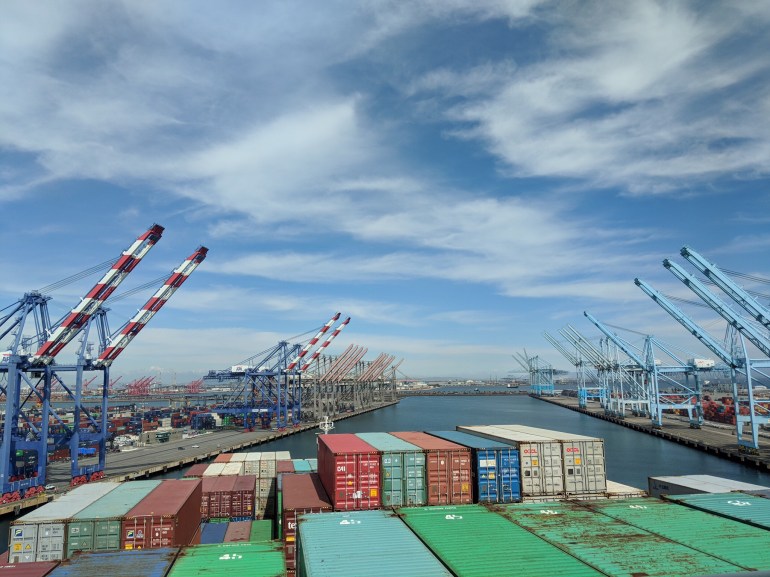
The short version I’ve been using in response to the “how was it?!” question is “equal parts peaceful, boring, comfortable, and weird.” There were more than a few magical moments — dolphins playing in our bow wave on the way out of LA; hundreds of little squid boats lighting up the night somewhere in the Sea of Japan; black kites swooping down to hunt swallows among the containers as we neared the port of Hong Kong — but there were some less magical ones too (hello, food poisoning in the middle of the sea).
If I complete this around-the-world-overland trip as planned, I’m going to have to get across the Atlantic sometime later this year. If I end up on a cargo ship again, I wouldn’t be sad about it. On the other hand… I might find an alternative mode of water transport, just to mix it up a bit.
 Grounded
Interesting story! I had heard about this mode of travel before, but after 4 years in the Navy and many trips back and forth across the Pacific I figured it was not something I would really want to do.
LikeLike
Interesting story! I had heard about this mode of travel before, but after 4 years in the Navy and many trips back and forth across the Pacific I figured it was not something I would really want to do.
LikeLike
Dear Lysee,
Thanks for the blow by blow details of the trip. You answered all the questions I could have possibly asked. Sorry the fish soup wasn’t like grandma’s. 😐 delighted you are enjoying visiting with yourself. What a gift and blessing to have. Got any art supplies for your creative time? Looking forward to your next entry.💕🤗😁💖
LikeLike
Wow !! So freaking cool! Can’t wait to see where you head next and how you do it.
LikeLike
Dearest Allyse, I enjoyed your 2nd entry. I’m going to be following your entries and can’t wait to see more. Pictures too. So sorry you had food poisoning. I can’t imagine how stressful and uncomfortable that must have been. I’m relieved that you actually made an accommodation with boredom, it sounds like you had your own floating mountaintop to meditate on.
LikeLike
This is the greatest! Loved the article. I could see having a yoga retreat en route. But the cost is a little bit much I think. 3k?! But I suppose airfare round trip would cost a fair amount and then on top of that 3 weeks of accommodation at the destination anyway….hmmmm.
Loved the article.
LikeLike
Allyse,
Thank you for the vivid account! I enjoyed reading this. May there be every good blessing. May the devas be with you!
Missing you!
Lisa
LikeLike
Loved reading this. Thanks for sharing. Fascinating to hear about the crew and their thinking. Definitely confusing to imagine how folks can both be genuinely caring and still support Duterte.
LikeLike
Oh and love to see more pictures of life at sea!
LikeLike
Informative and brilliantly written, thanks!
LikeLike
right after trump was elected, you posted the most brilliant thing i had seen. something about maybe moving to a very red state to get to know a population so foreign to you. i think you are kind of doing this on a global level now. so impressed and inspired!!
LikeLike
Great article! I guess my biggest question is “Why a cargo boat instead of a cruise ship?” I assumed you took a cargo boat to save money, but given the cost I’m not actually sure you did save any money. Are cargo boats somehow better for the environment, or do you hate cruise ships, or were there no cruise ships headed where you wanted to go? Just curious…
LikeLike