
Right now I’m in Copenhagen, but three weeks ago I was in in China: a lot of ground in not a lot of time.
I got to Europe via the famed Trans-Siberian railroad — the longest stretch of continual rail in the world. Well, technically I traveled the Trans-Mongolian railroad, rather than the Trans-Siberian, since I started in Beijing rather than Vladivostok. At 4,735 miles, it’s just a *bit* shorter than its more famous cousin, but the majority of the route to Moscow is the same.
I set out from Beijing’s main railway station on a Tuesday, and had a four-bed soft sleeper compartment all to myself. The train was Chinese and comfortable, although trying to order food was a challenge, per usual. There’s very little English proficiency in China in general, and translated menus are rarer than unicorns. (When you’re big enough to have the world’s most popular TV show and virtually no one in the English-speaking world *has even heard of it*, there’s very little need or incentive to learn English.)
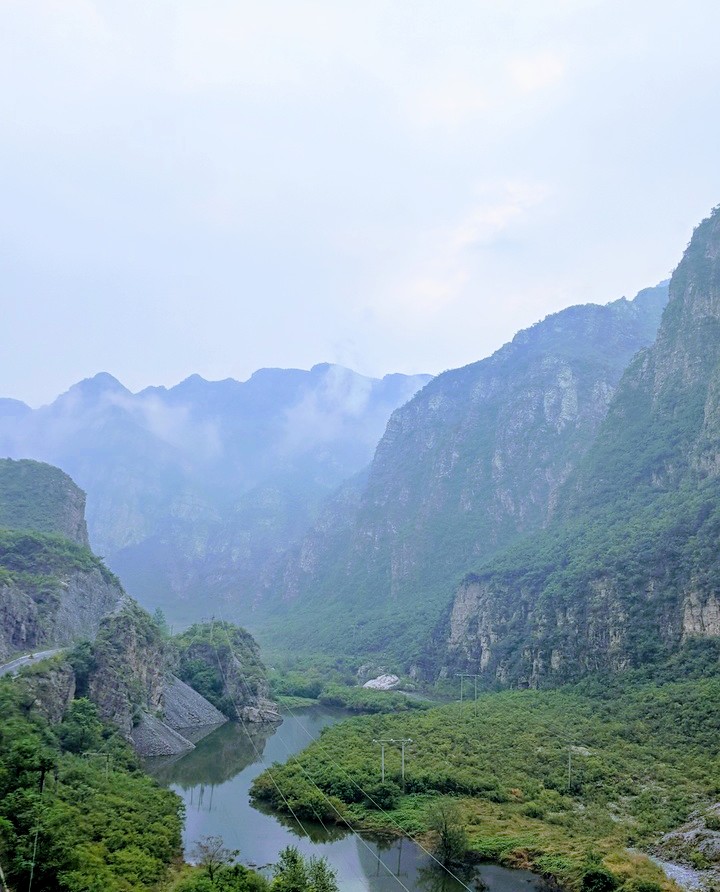
The train passed through Beijing’s sprawling suburbs, and then for the next many hours sped through what almost seemed like two Chinas, existing alongside and overlapping with each other: the one pastoral, gorgeous, and green, and the other gray and industrial and huge. I remember emerging from my little cabin at one point to the sight, framed in the windows across the narrow hall, of an exquisite steep-sided gorge, with a lake or a river at its base, like something out of a Chinese landscape painting. We also saw a lot of factories though. There were probably more factories than exquisite gorges.
On the Mongolian border, we were treated to a bizarre ritual: the Chinese wheel units were swapped out for Mongolian ones, because the track gauge in Mongolia and Russia differs from China’s. This was accomplished by driving the train into a big warehouse and lifting the thing wholesale, passengers and all. It was kind of awesome and kind of excruciating: they locked the bathrooms for over three hours and kept us all up until 2 am.
Mongolia
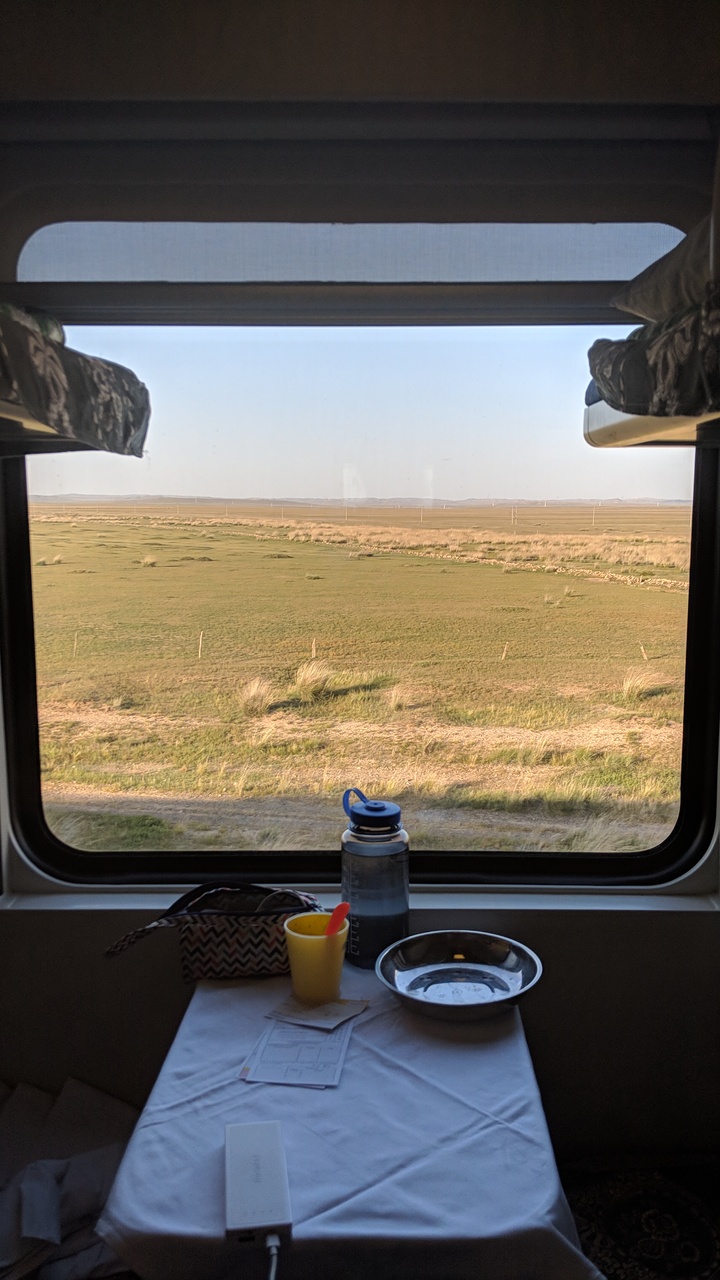
I slept through most of the Gobi desert the next morning, unfortunately, and by the time I roused myself the sand was starting to give way to scrubby grasslands. We pulled into Ulaanbaatar in the early afternoon, where I met my guide, NK, and was immediately taken out to the broad, grassy, big-sky countryside.
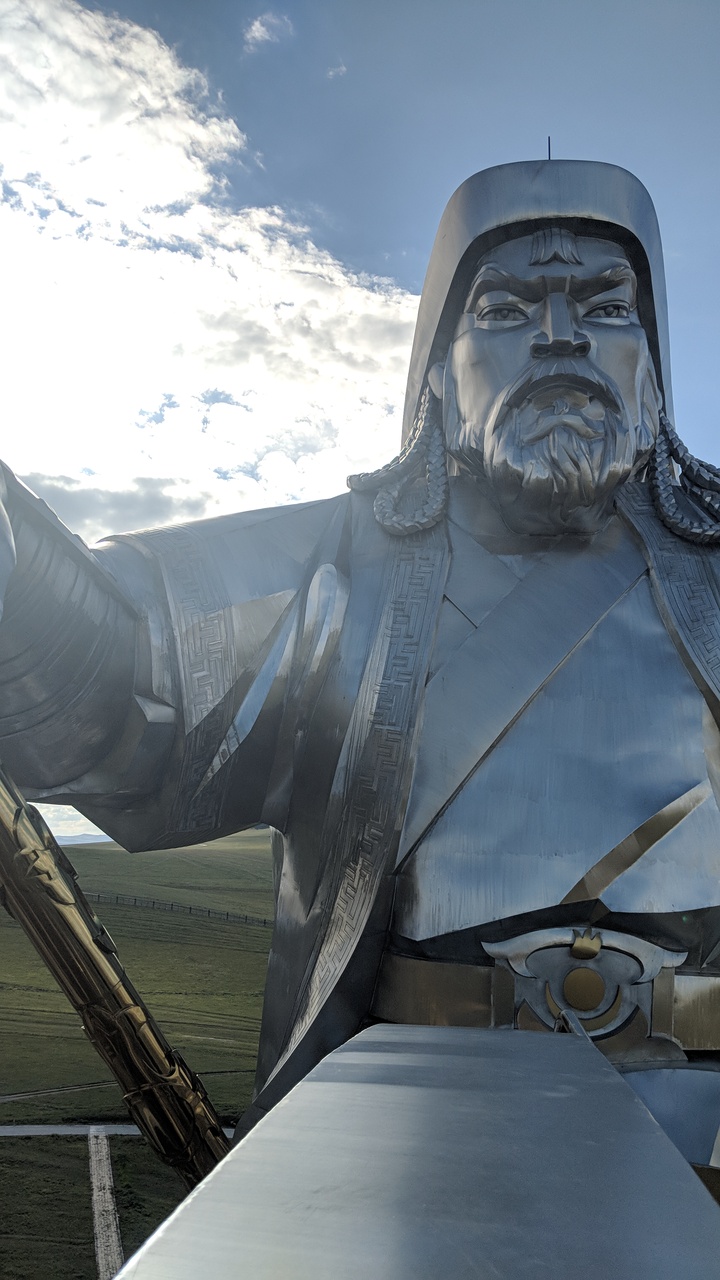
We hit Mongolia’s premier sightseeing spot along the way: a giant, 40 meter tall stainless steel statue of a mounted Ghengis Khan bestriding the steppe. It was built by a private businessman, who happens to now be Mongolia’s president, as a simultaneous money-making endeavor and patriotic gesture. (I suppose it is *somewhat* understandable, but the Mongolians are still surprisingly enamored of Mr. Khan, given that he was a ruthless, genocidal conqueror.)
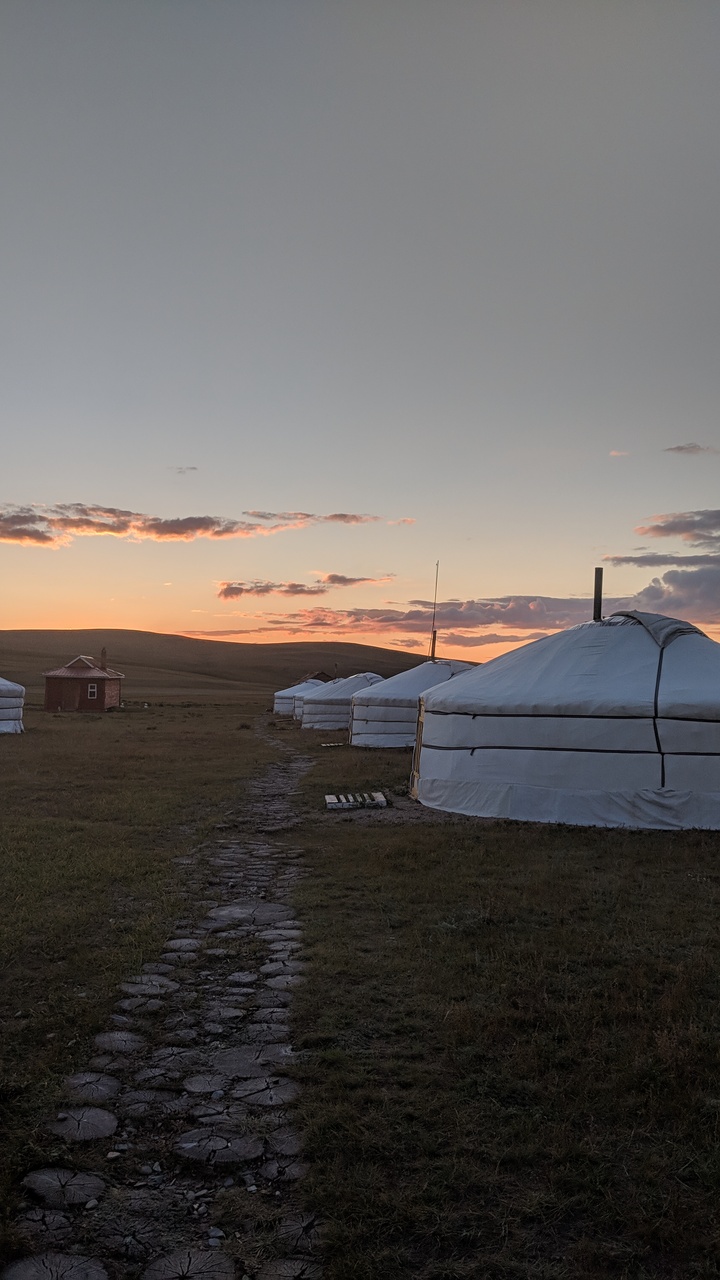
I spent two nights in one of the many “ger” or yurt camps that dot the otherwise featureless hills around Ulaanbaatar. Some of the little round white dwellings belong to families of nomads, but most of the ger close to the city are tourist camps that fill up during the brief summers and then empty out again in early fall, around the time I arrived.
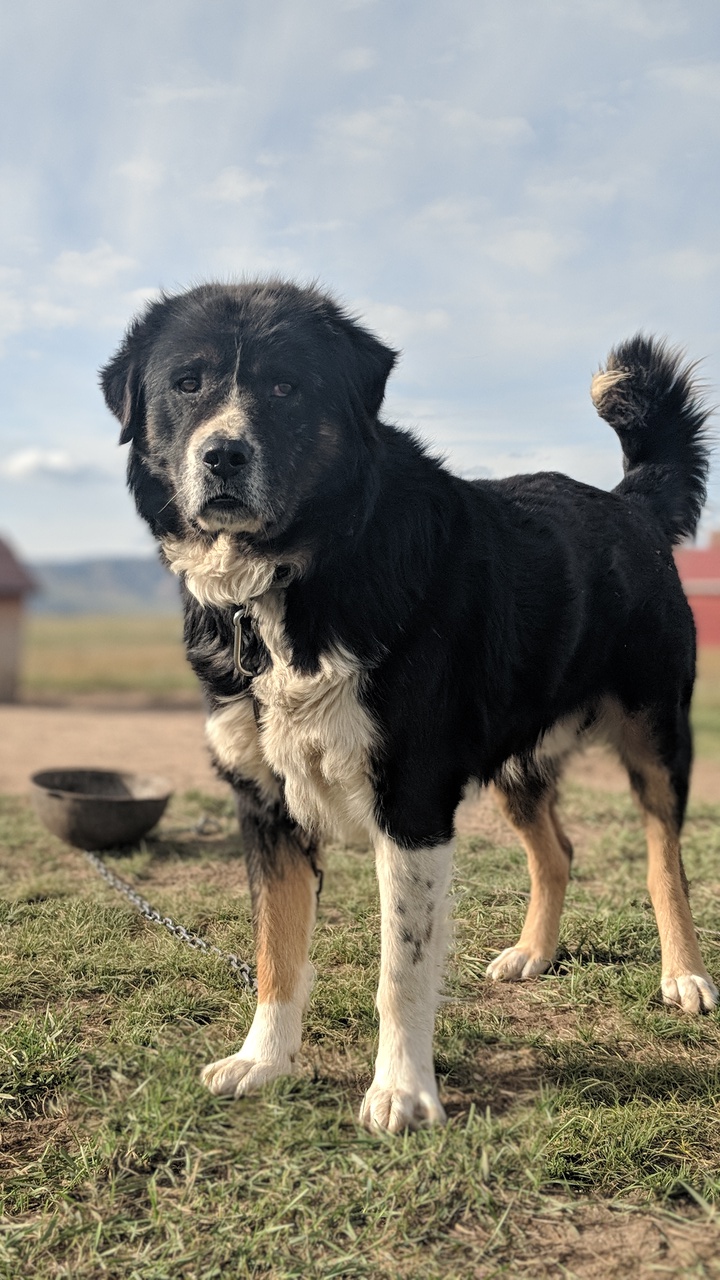
I was the only guest in my camp, aside from my guide. It reminded me a little of crossing the Pacific as the only passenger on a cargo ship: empty space, inky dark skies, just a few people about busy doing their jobs. I liked it a lot (except, perhaps, the long walk in the bitter cold darkness to the restroom at night). I spent my time reading in my cozy ger, taking long walks in the rolling hills, and befriending the huge, thickly furred, desperately friendly guard dogs who were chained up at intervals around the property.
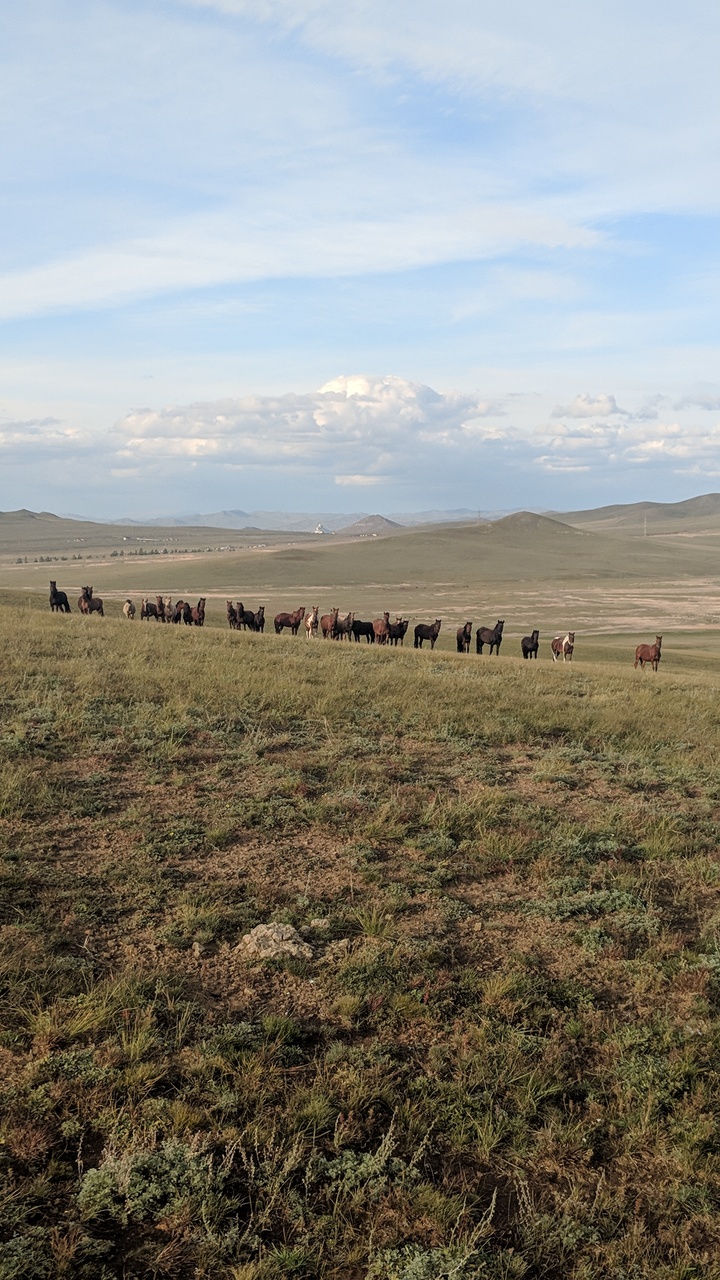
The camp was also full of horses. There are very few fences on the Mongolian steppe — for a people with nomadic roots, they just don’t make a ton of sense — and the several herds of horses grazing in the surrounding area would just sort of wander in. I wanted desperately to make friends with them too, but they would come close and then skitter away just as I got within arm’s length. They are owned, but not tamed.
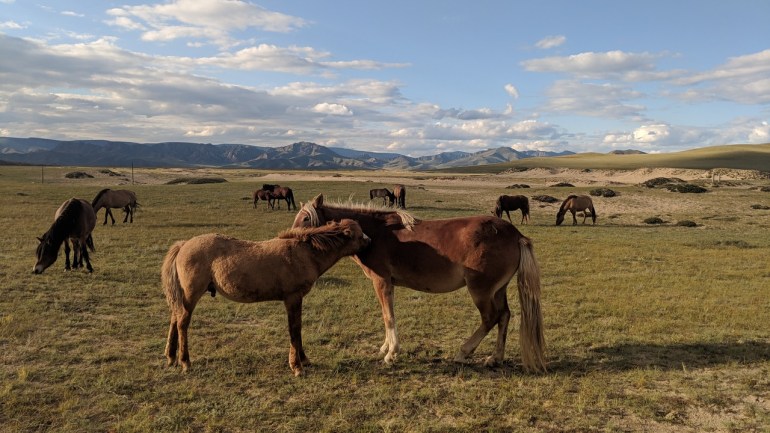
NK and I trooped across the fields one day to visit the neighboring nomad family, who owned the many horses, sheep, and goats wandering about. As we came up on the camp, the family was milking mares: The foals were tied up to keep the mothers close, and the mares were roped up one by one. The family took whatever milk they estimated the babies could spare, and then let mom and baby loose to rejoin their herd. Afterwards, we sat in the family’s ger and drank fermented mare’s milk — a decidedly acquired taste — while NK attempted to translate a somewhat stilted conversation and their kiddo pretended to shoot a bow and arrow.
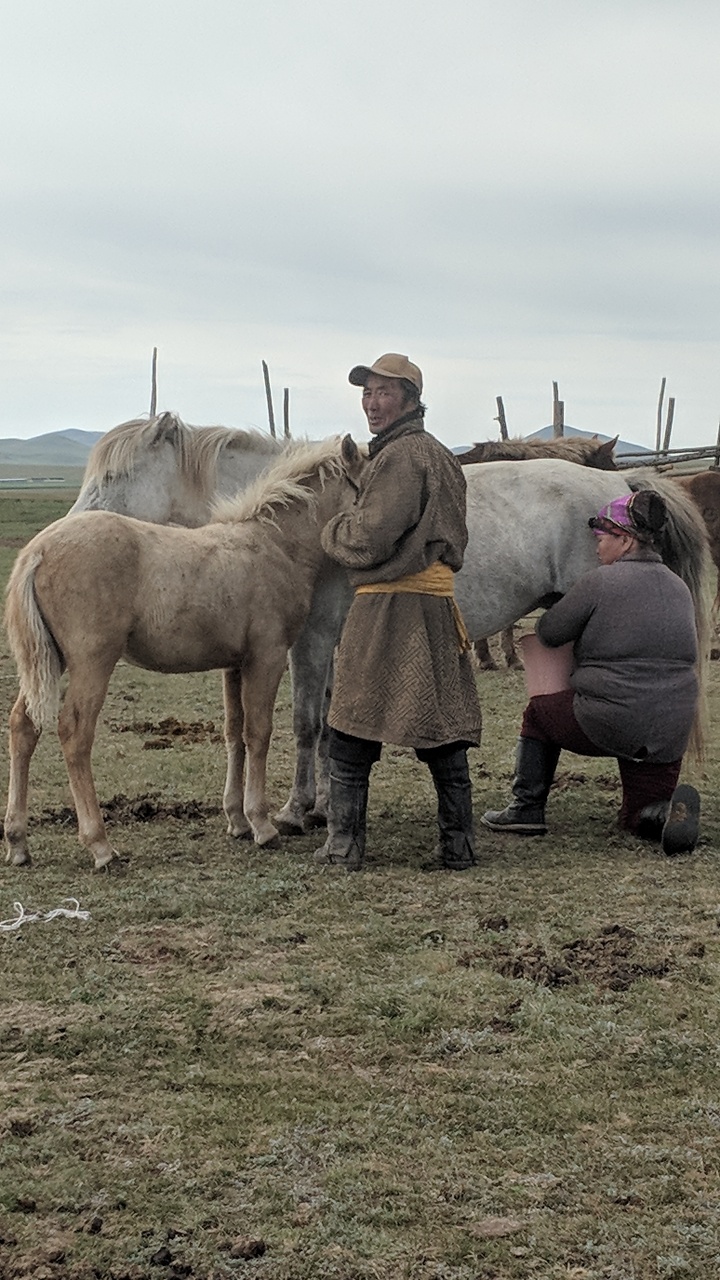
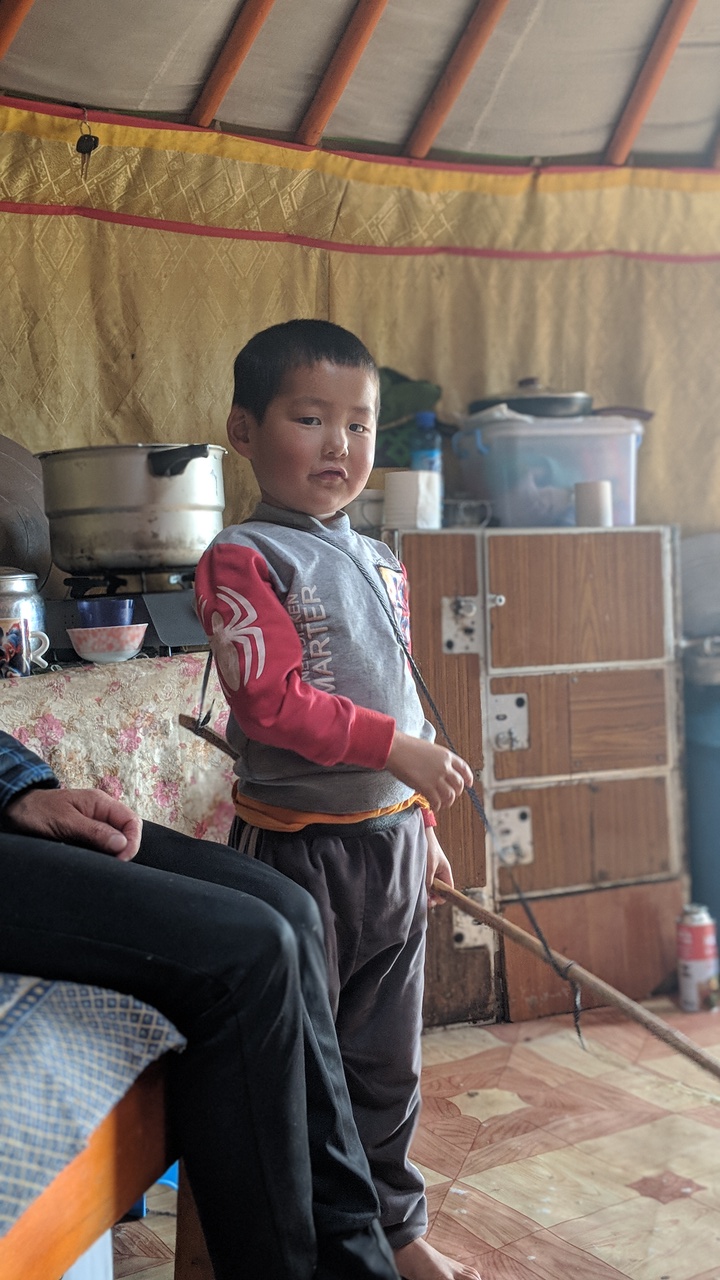
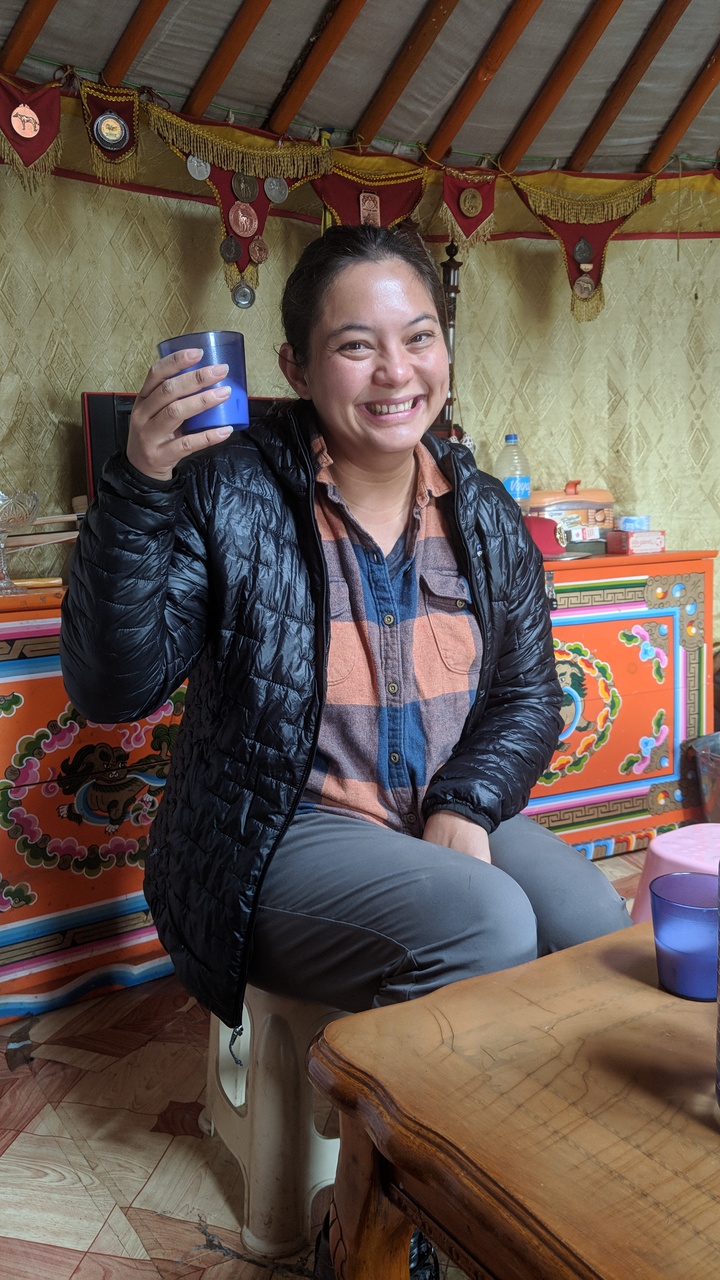
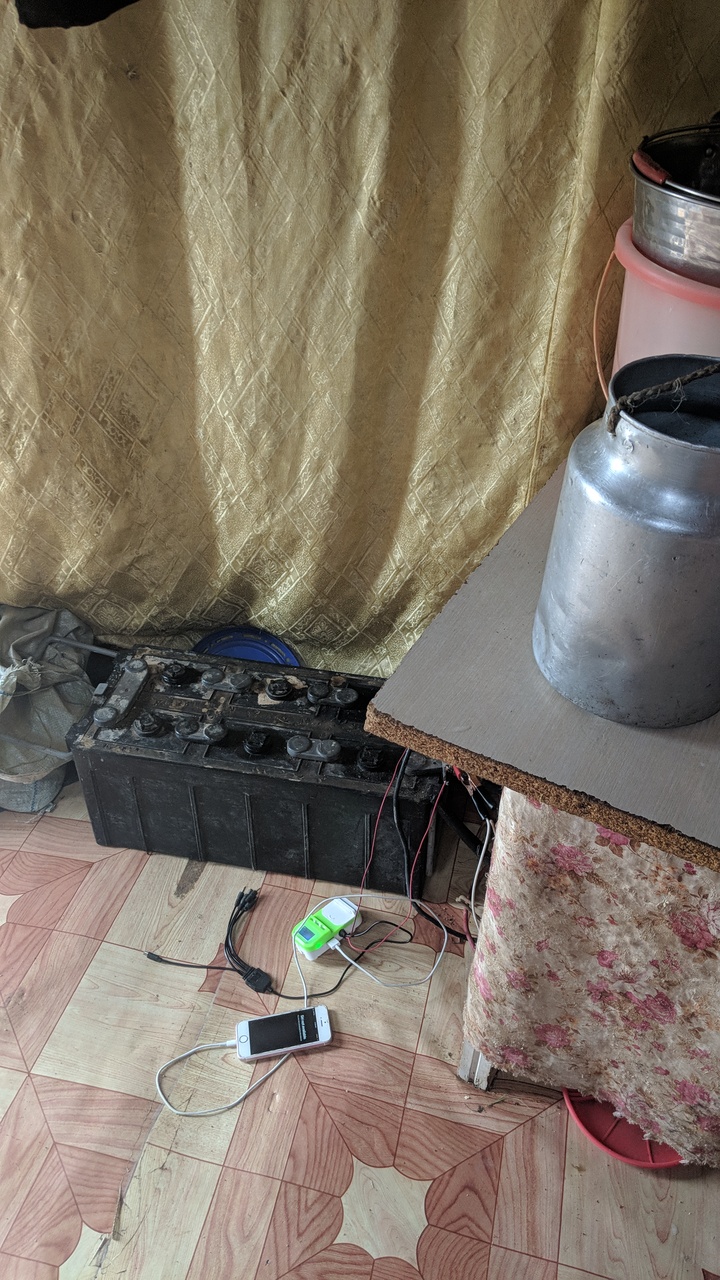
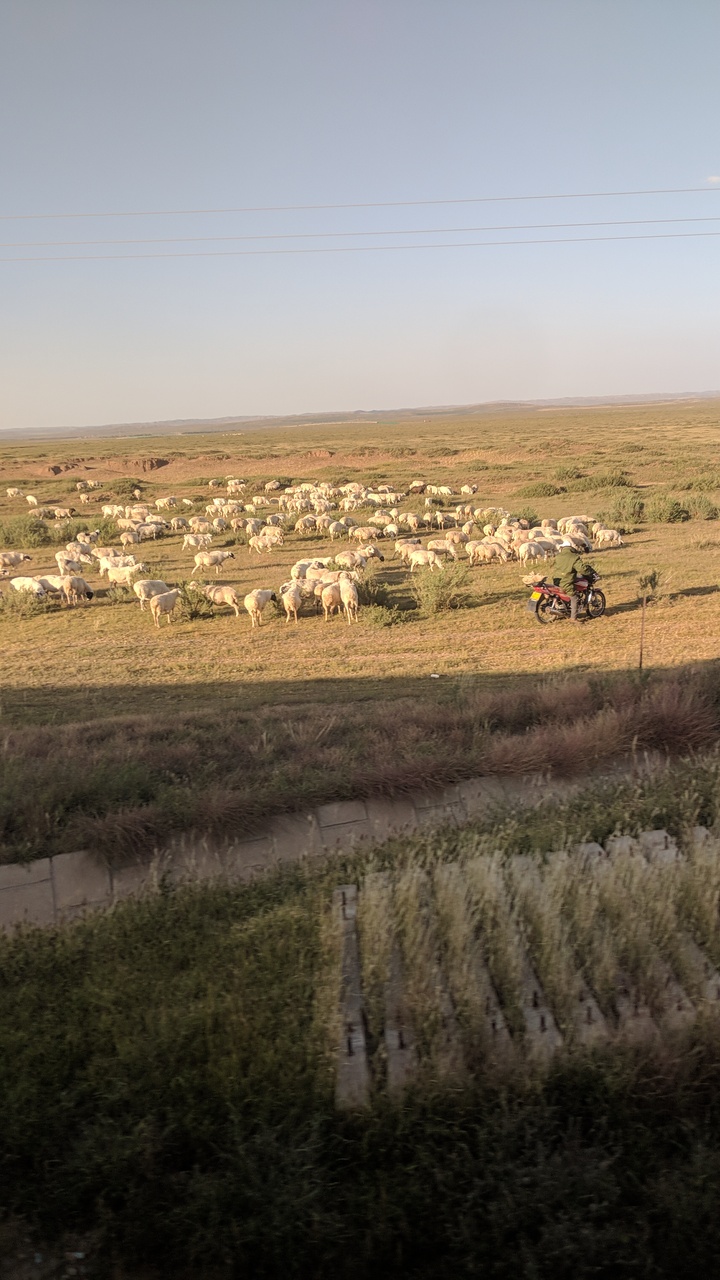
The Mongolian population is still about 30% nomadic. These people live a rather solitary life, traveling in family units between summer and winter campgrounds (winter camp being near the mountains, which offer a bit more shelter from the wind) along with their large herds. The nomads are not typically poor — my own neighbors must have had something like 300 head of livestock, a veritable fortune — and it’s a chosen lifestyle, by and large. They have solar panels and mobile phones, and much of the actual herding happens on the back of a motorbike rather than a horse.
That said, the nomadic population is certainly shrinking, as young people gravitate toward urban jobs. About half of Mongolia’s 3 million people now live in Ulaanbaatar, an odd, uncomfortable city full of roaring wind, dusty traffic, and new high-rise condos springing up amongst the little yards of ger. It’s the world’s coldest capital city, and outside of the new fancy high-rises, many residents still burn coal to heat their homes. I spent one night in Ulaanbaatar, where I met up with a friend I’d made in Tibet for a fancy hot pot meal, and then nearly froze my butt off on the walk back to the hotel. It was enough.
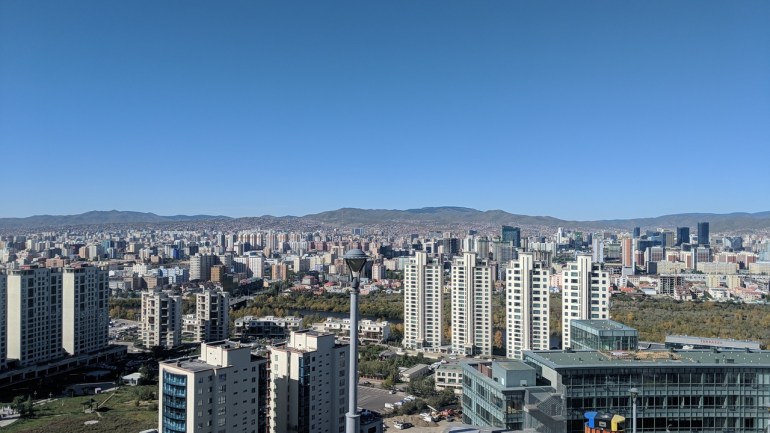
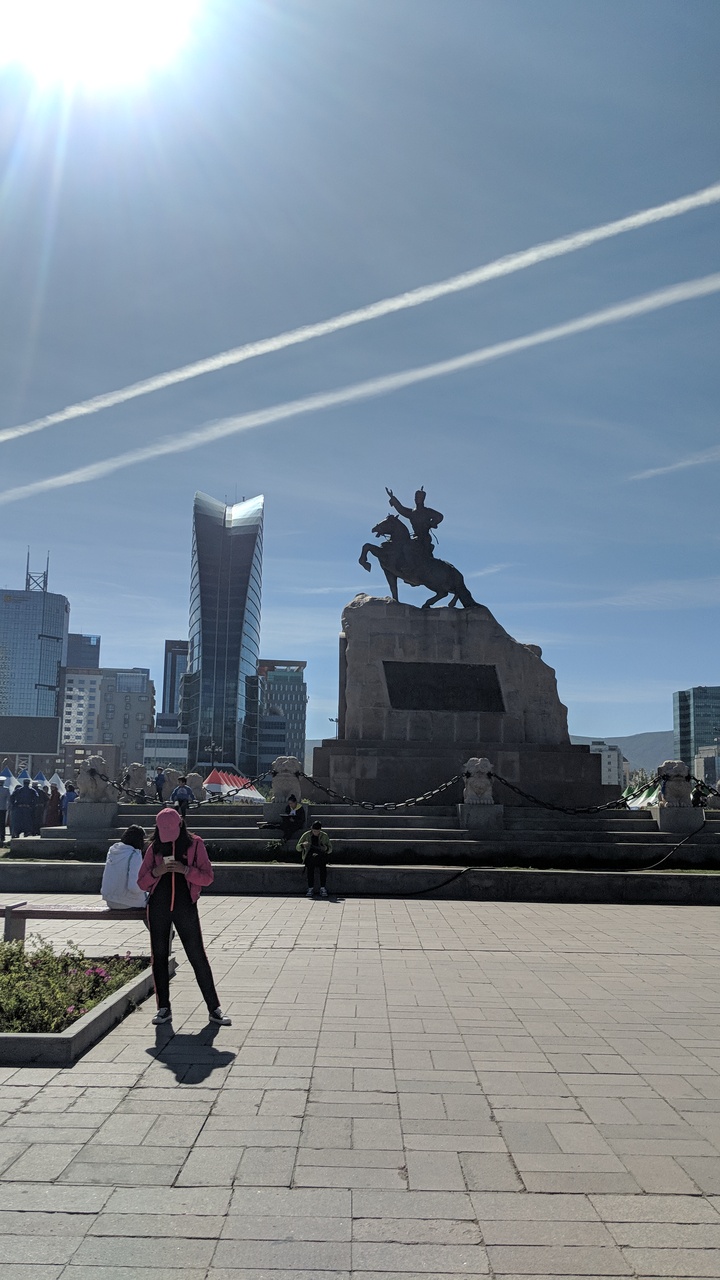
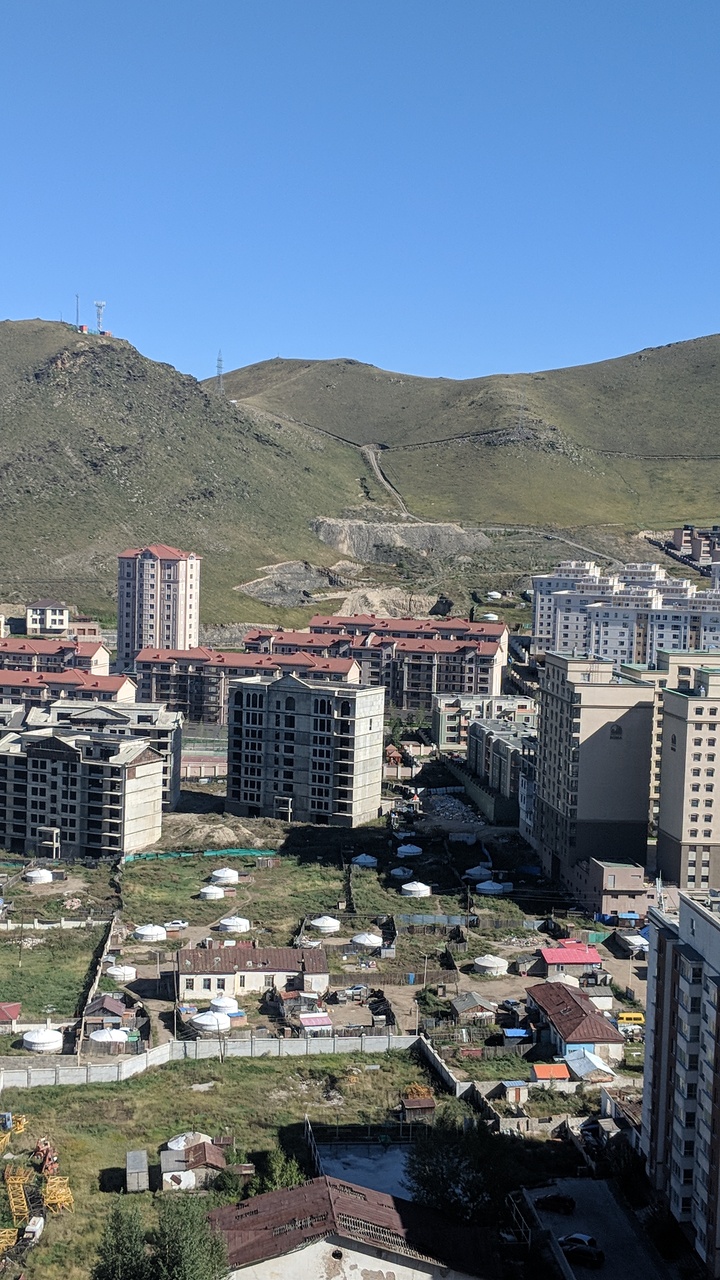
The boom in UB is largely driven by the mining industry. Mongolia has significant deposits of coal, gold and copper, and the country sees these resources as their ticket to development. I talked about this with NK over breakfast one day.
“Mongolia is rich. We’re rich in natural resources,” he said. “But the people don’t see any of the profits. I’m very disappointed in this government.” Why disappointed? “Because they always say it will be different. We vote out the one party, vote in the other one, and expect things to change. But it’s still the same two parties taking turns.” I told him this sounded a lot like the United States. “The politicians, they just get rich doing deals with foreign companies. Then the foreign companies get rich mining Mongolian gold. They get a great deal. But regular Mongolians get cheated.”
I told NK that this sounded like a familiar story. Like most countries, really, that find themselves in possession of big reserves of valuable natural resources, especially but not exclusively fossil fuels.
“It’s like in Africa,” he said, and I asked him to explain. “It’s like when the countries in Europe went to Africa and took all the valuable things. The natural resources. And the Africans didn’t get any of the profits.” Ah, like colonialism, I said. “Yes, like that.”
Siberia
Back on the rails for another night, this time on a classic Russian train, complete with always-on samovar at the end of the hall and an at-turns jovial & stern provodnitsa, or car attendant (kind of a cross between the car-mom & an enforcer).
I rode in a second class four-bed cabin again, which I shared with a nice Slovenian engineer, a Russian woman who was very friendly and sweet but spoke a spectacularly broken English, and an extremely outgoing Englishman who supported Brexit and wanted to talk about “solving the race problem” (he thought black people in the UK had it real good these days; I tried to explain structural racism and inter-generational trauma). We shared some booze and some chocolate, and the next morning I woke up in Siberia.
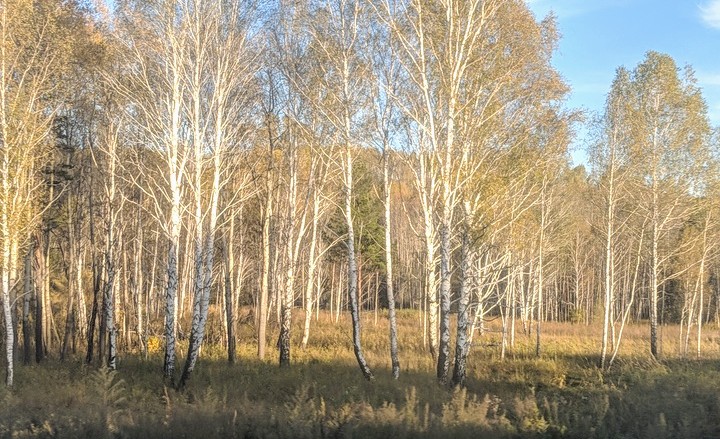
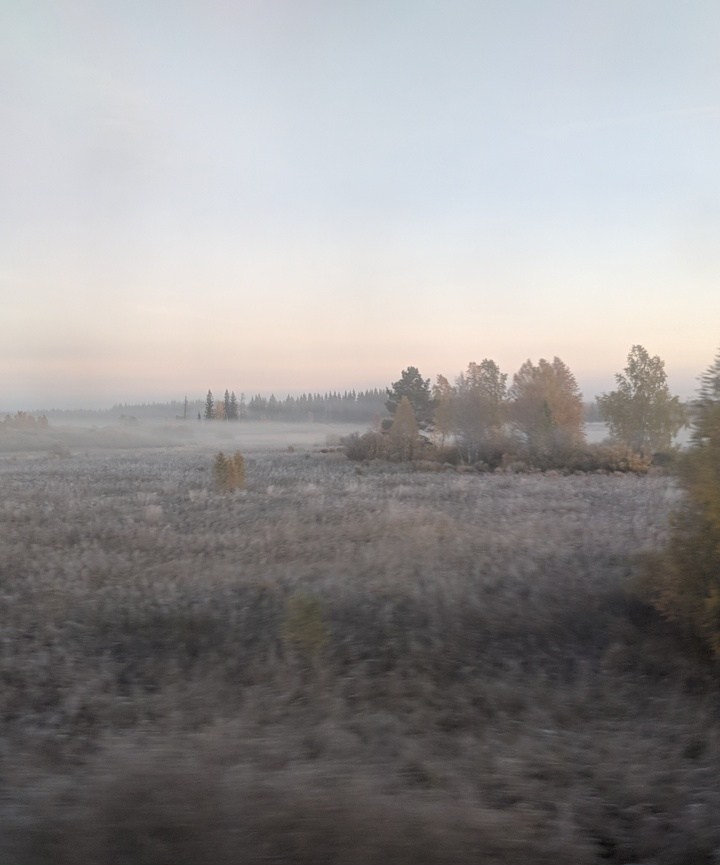
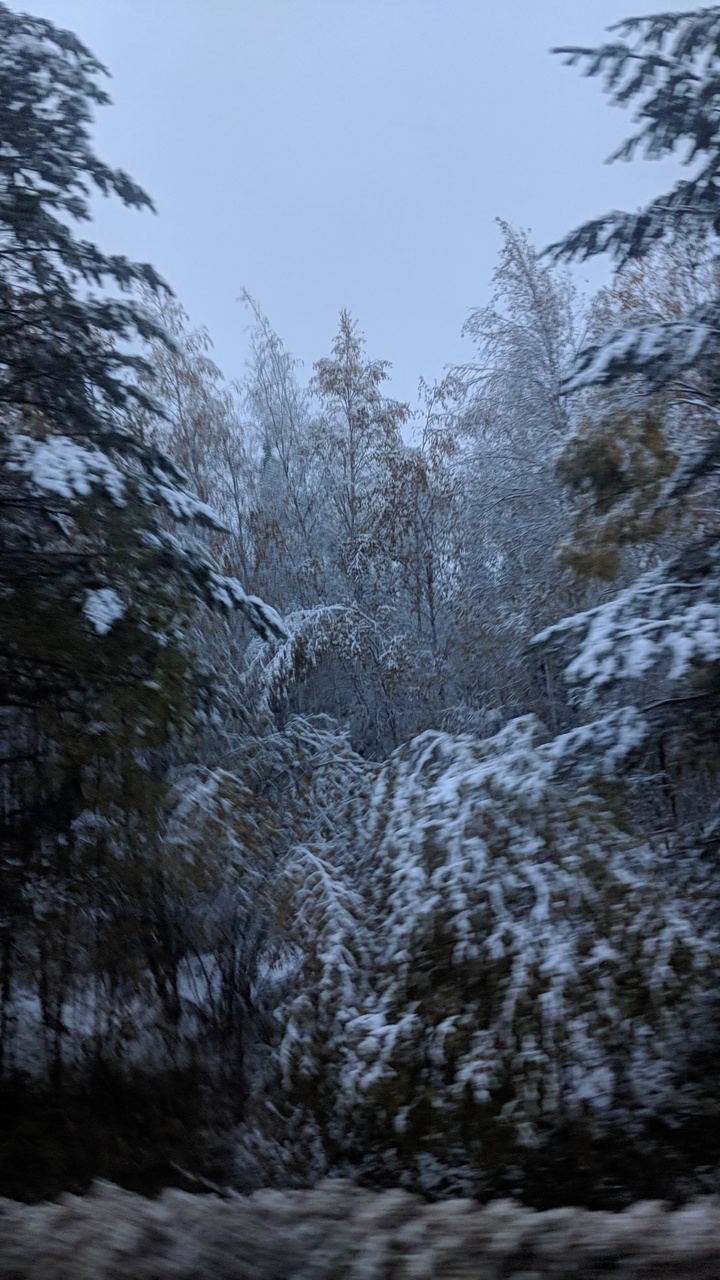
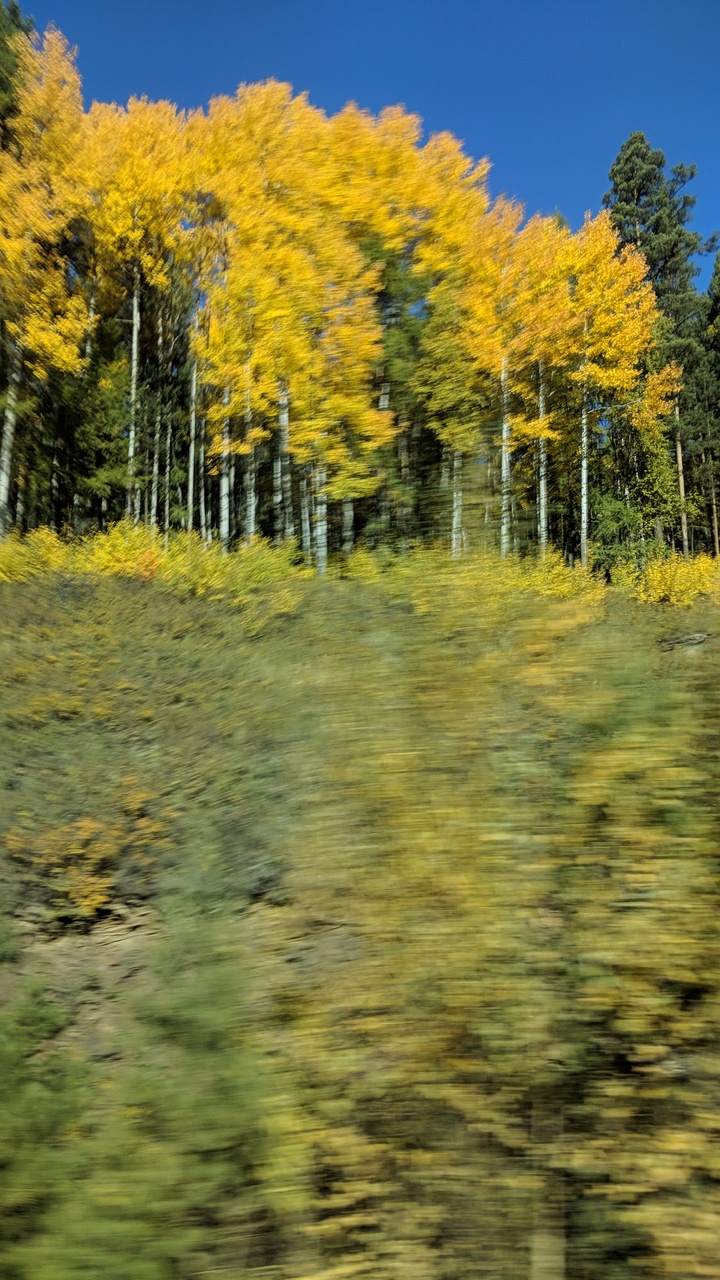
I loved Siberia immediately. I couldn’t get enough of the silver birch forests that lined the train tracks and were just starting to yellow after the first frost. I spent hours looking out the train windows and trying to spot the difference between the birches (flaky silver trunks, narrower, golden brown leaves) and the rarer aspens (smoother silver trunks, rounder leaves, edging through yellow into red).
I met my new guide in Irkutsk, the Siberian capital, and then we drove out to a tiny village on the shores of Lake Baikal, where we spent two nights. Lake Baikal is the world’s deepest lake (1,642 meters) and the largest by volume (23,600 cubic kilometers). It’s big, and seems bigger by virtue of isolation, but it’s not so big that you can’t see the other side; yet Lake Baikal holds a mind-boggling 22-23% of the world’s fresh surface water.
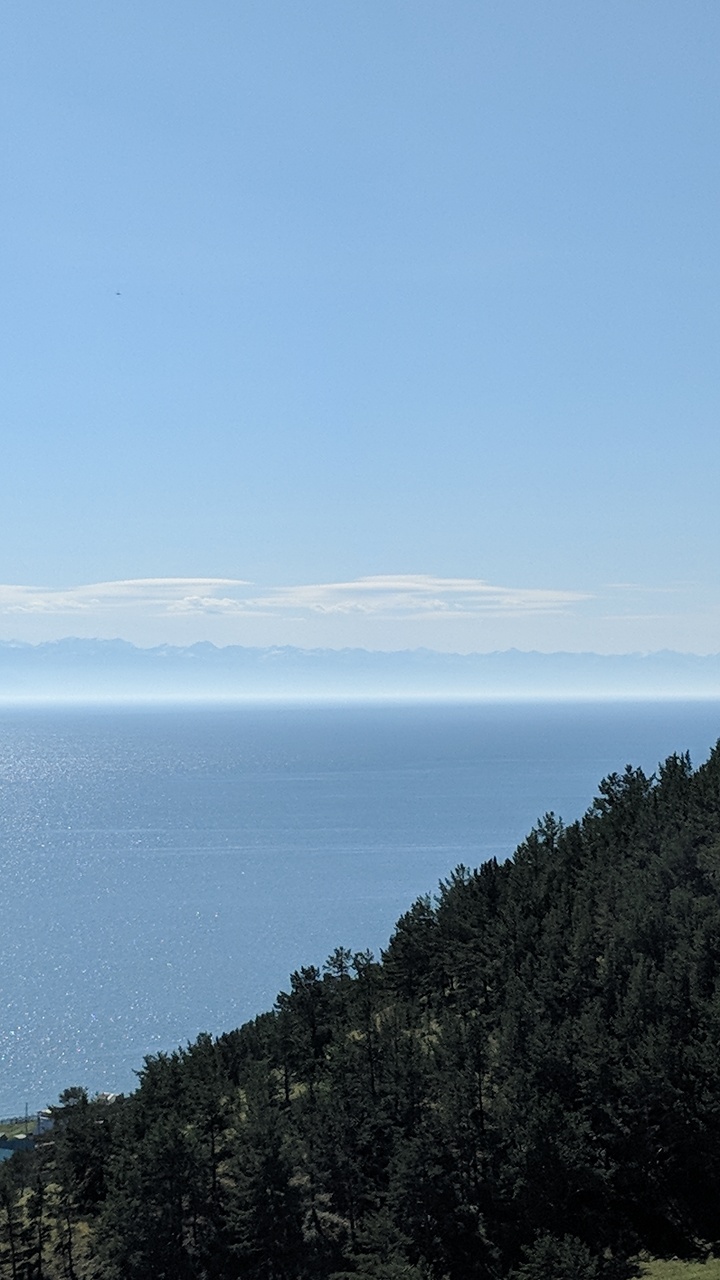
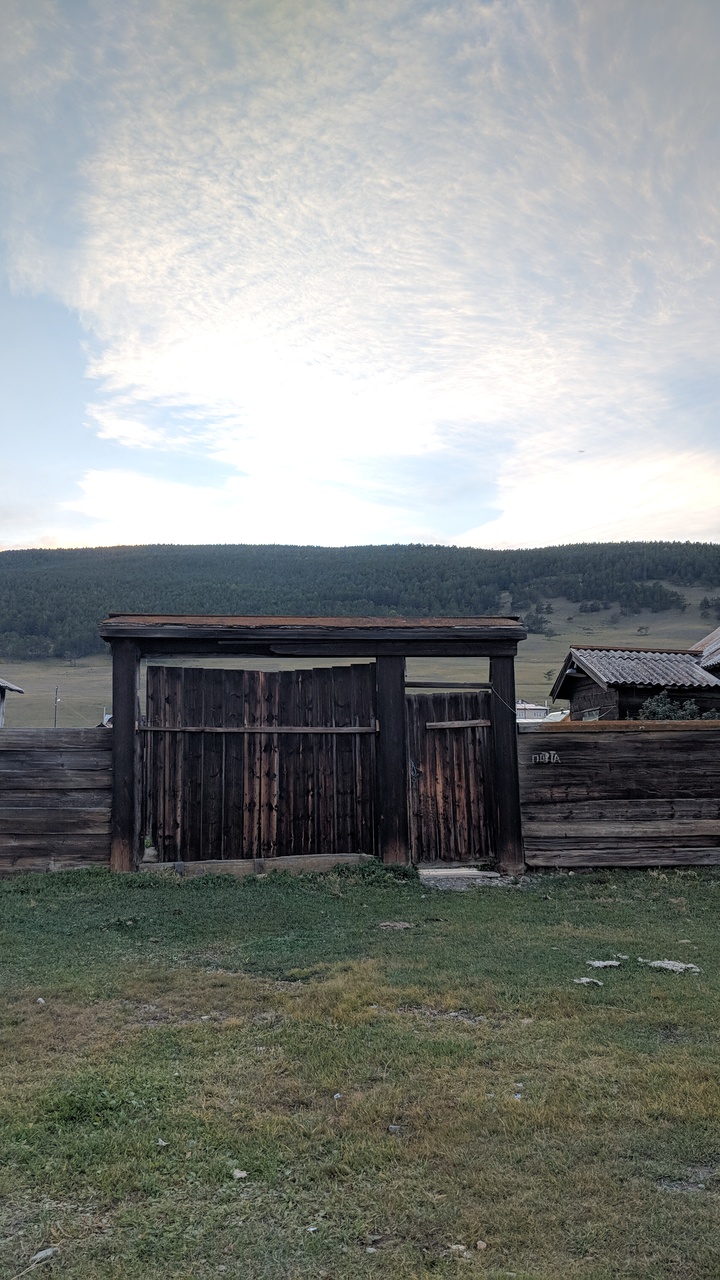
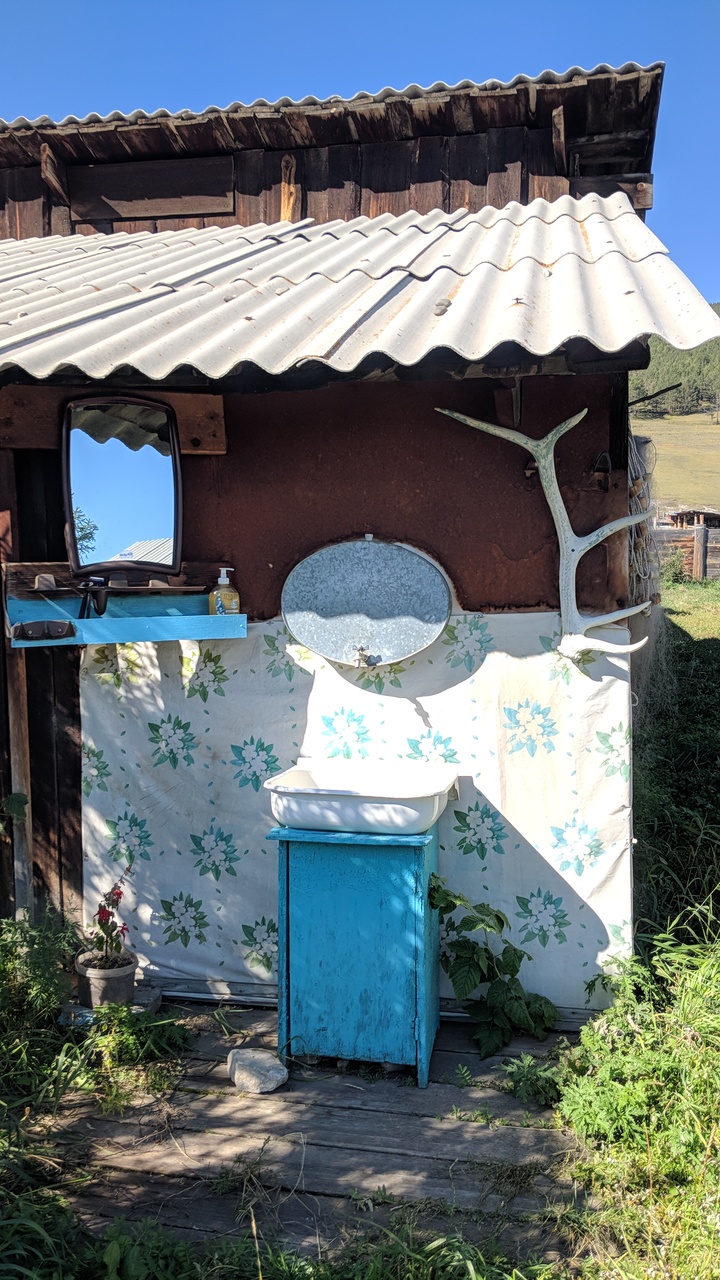
The lake dominates the region, affecting the winds, the weather, and the culture. There are scattered villages around the shore, which get sparser further north. Many of the people once fished, but right now there’s a temporary moratorium to help the fish populations rebound. Now, most people cobble together a living from a combination of farming and small tourist-oriented businesses. In Bol’shoye Goloustnoye, where I was, toward the southwest shore of the lake, the villagers were a combination of Russians and indigenous Buryats, an ethnic subgroup of the Mongols who supposedly moved north because they didn’t want to be part of Ghengis Khan’s campaign for world domination.
My guide Oleg and I spent a couple of hours rambling around the tiny town, looking at the little wooden houses trimmed in green, blue, and white, and trying to find somewhere to buy smoked fish. Bol’shoye Goloustnoye’s shops probably number less than ten, all of which kept pretty irregular hours, but we finally found a nice Buryat woman, the mom of Oleg’s friend, who was willing to open up her little shop for us.
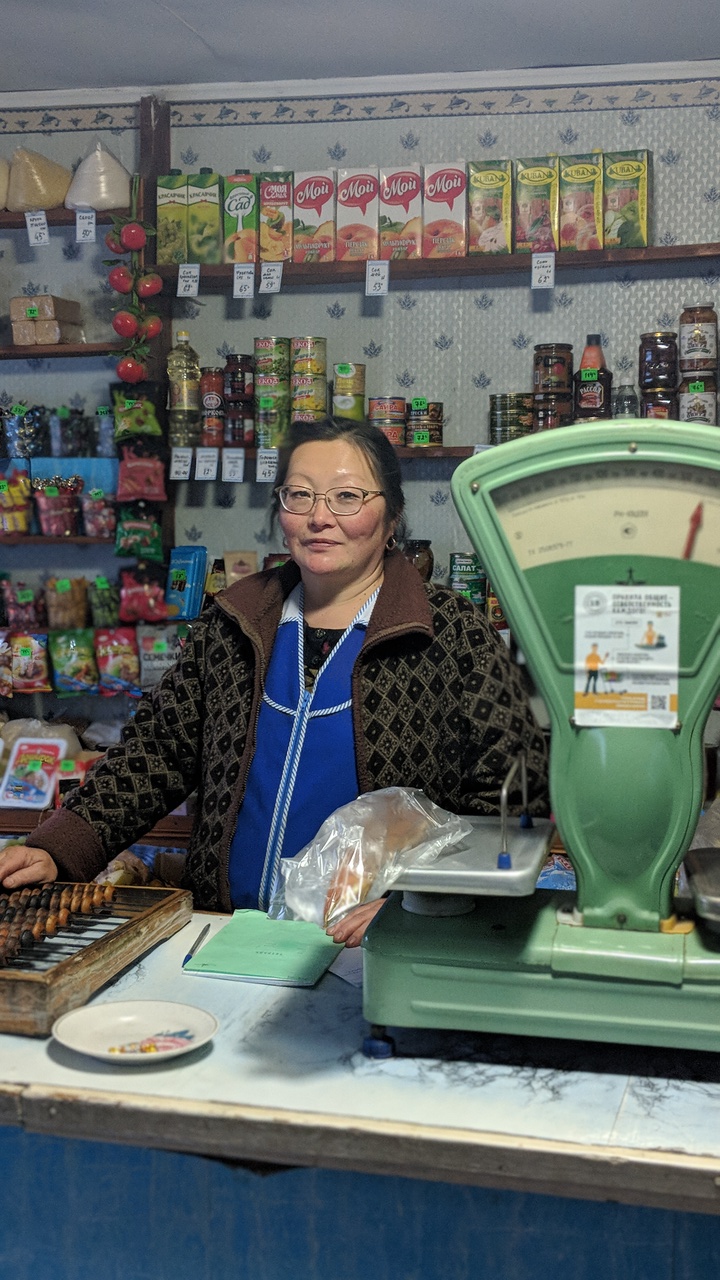
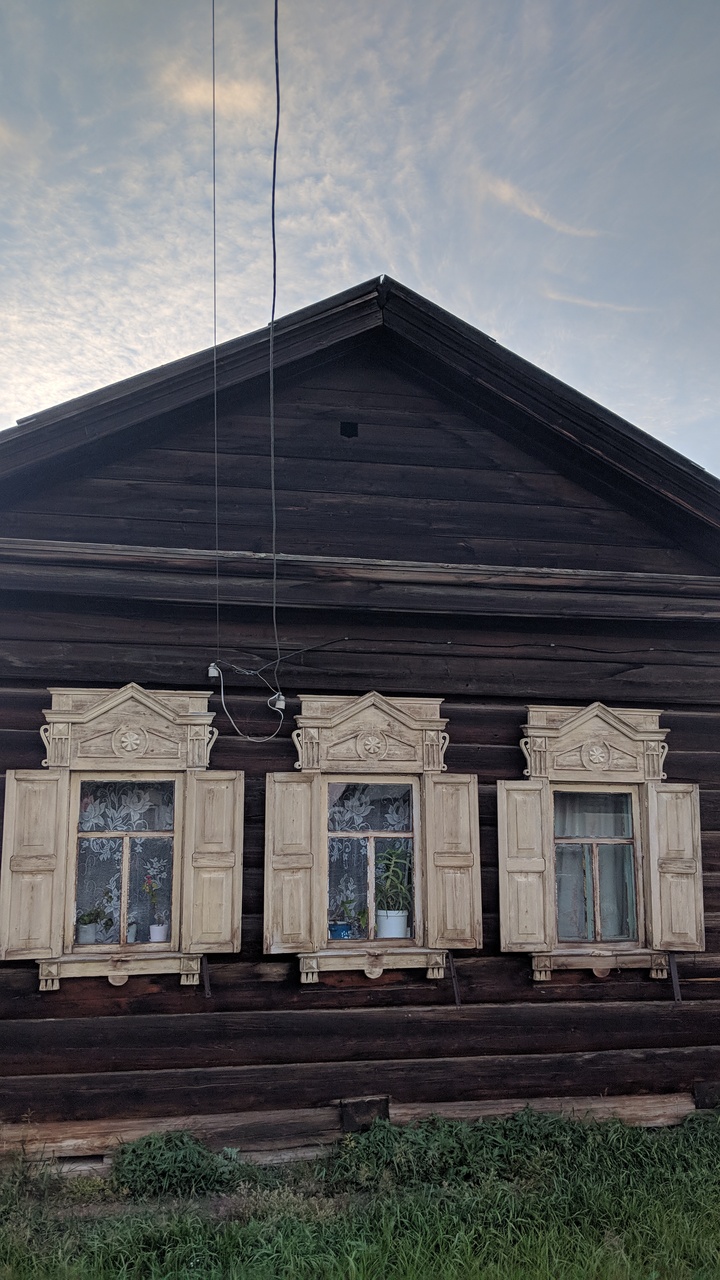
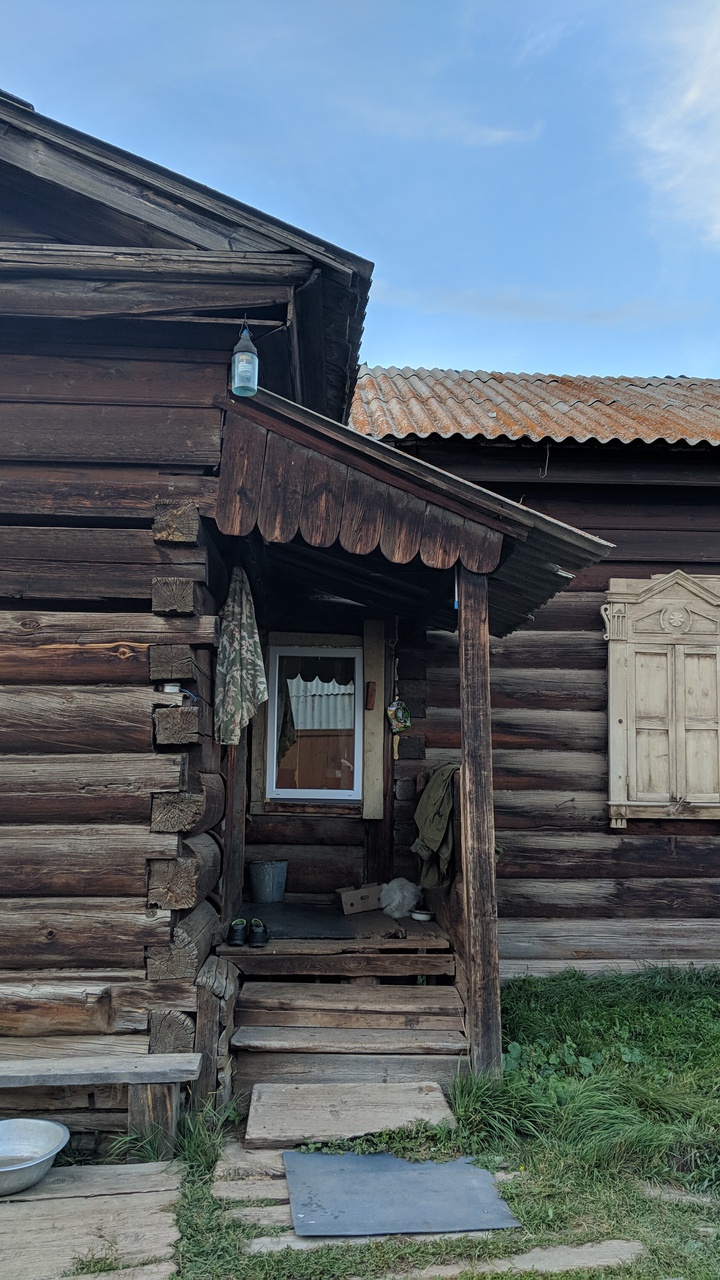
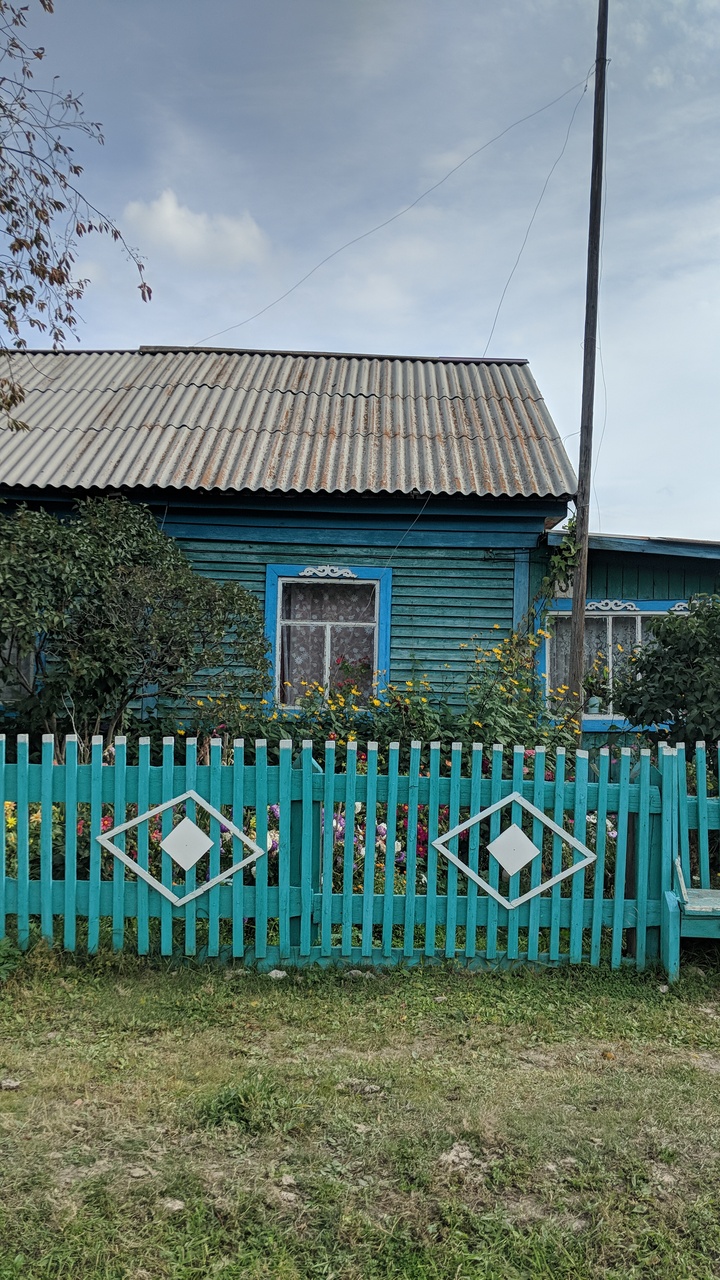
We also spent an afternoon hunting Chanterelles in the surrounding hills. Mushroom hunting is basically my favorite pastime, and this only cemented a Siberia-love at that point already well established by birches, borscht, and banyas. This was only a little complicated by my low-level terror of running into a brown bear — which aren’t uncommon in the thickly forested hills surrounding much of the lake — and the fact that some much-more-effective mushroom hunter seemed to have covered the same ground not long before us.
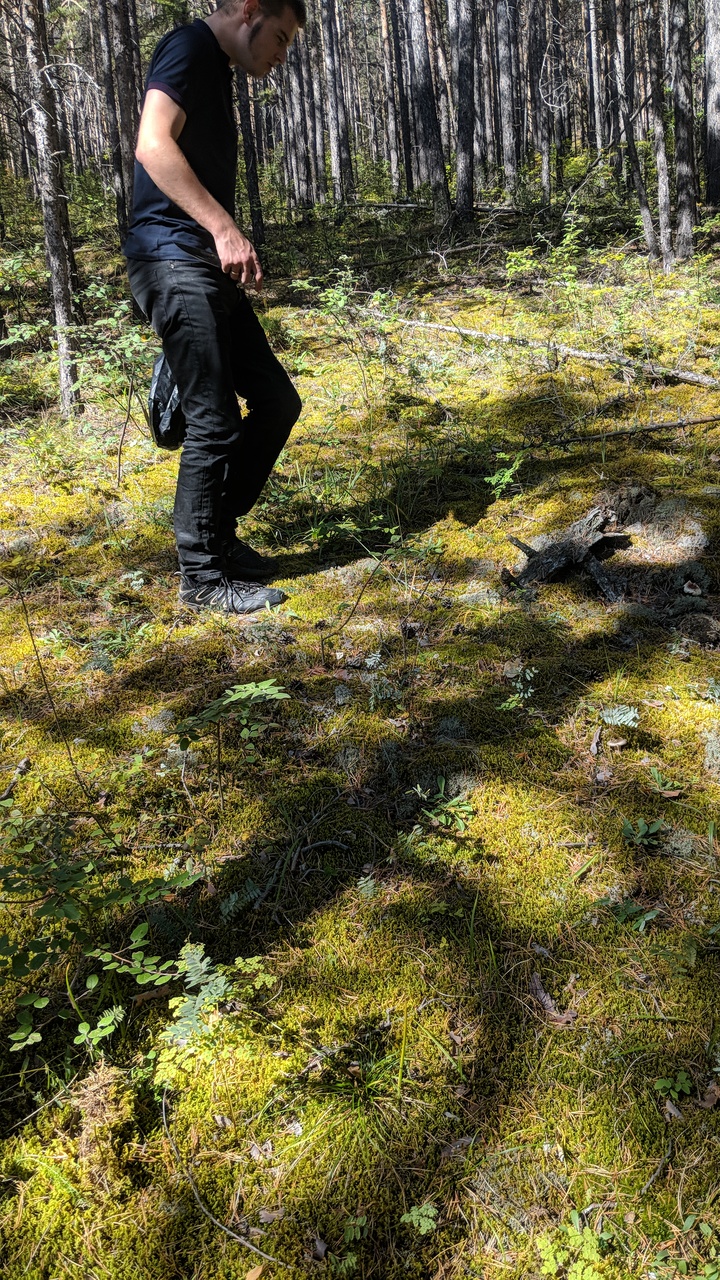
Oleg was an affable young guy with thin mutton-chops and a leather jacket, who liked singing along to heavy metal YouTube videos and seemed to know everyone in Irkutsk. Until recently, he sold sausages for a living, but now that he had a kid his wife wanted him to make more money. He believed strongly in shamanism and knew everything about spiders (though not, alas, a whole lot about mushrooms). I liked him.
Over lunch one day, I asked him about climate change, about whether people in Siberia notice it and worry about it.
“Yes, of course,” he said. “The climate is changing and it’s just going to keep going.” He paused, and I made some noise of agreement. “You know what’s causing it? You know about how the magnetism is changing?” I said I did not know about that. “Well, the earth is like one big magnet, and the two ends of it are moving. They’re switching places.” I said I didn’t know anything about the magnetic poles moving, but what about the climate change that was related to burning things like gas and coal? “I don’t know about *that*,” he said. “But I know that the climate is changing. The ends are switching. Someday in a couple hundred years or so, Hawaii will be like the Arctic and Siberia will be, like, tropical.”
Eventually Oleg and I had to agree to disagree on the finer mechanisms. The conversation left me feeling sober about the way information moves and spreads — or doesn’t — and melancholy about the future of Siberia, tropical or no.
European Russia
I spent three straight days on the train from Irkutsk to Moscow. I think I got off once, for literally two minutes. Thankfully, I’d booked that leg on one of the nicest trains available, the “Rossiya.” It was neat and comfortable, with a sleek new dining car that served solidly passable, shockingly expensive food and was nearly always empty.
One overall disappointment of the trip was the lack of real platform-life, which was in contrast to to the vibrant scenes in all the Trans-Siberian accounts I’d read and heard. Evidently the government has recently cracked down on the tradition of old ladies selling home-cooked products to travelers on the platforms, which meant that my affordable eating choices consisted of instant noodles, instant oatmeal, and instant potatoes. (Fucking fascism, man.)
My cabin-mate was a matronly Russian woman who spoke not a word of English and took awhile to warm up, but by the end was enthusiastically pressing Kielbasa on me. We were joined for a night by two men on a business trip, the older of whom tried to get me to drink more vodka than seemed wise or palatable. I consented to a little bit in the evening, but had to draw the line at 9:00 am vodka shots.
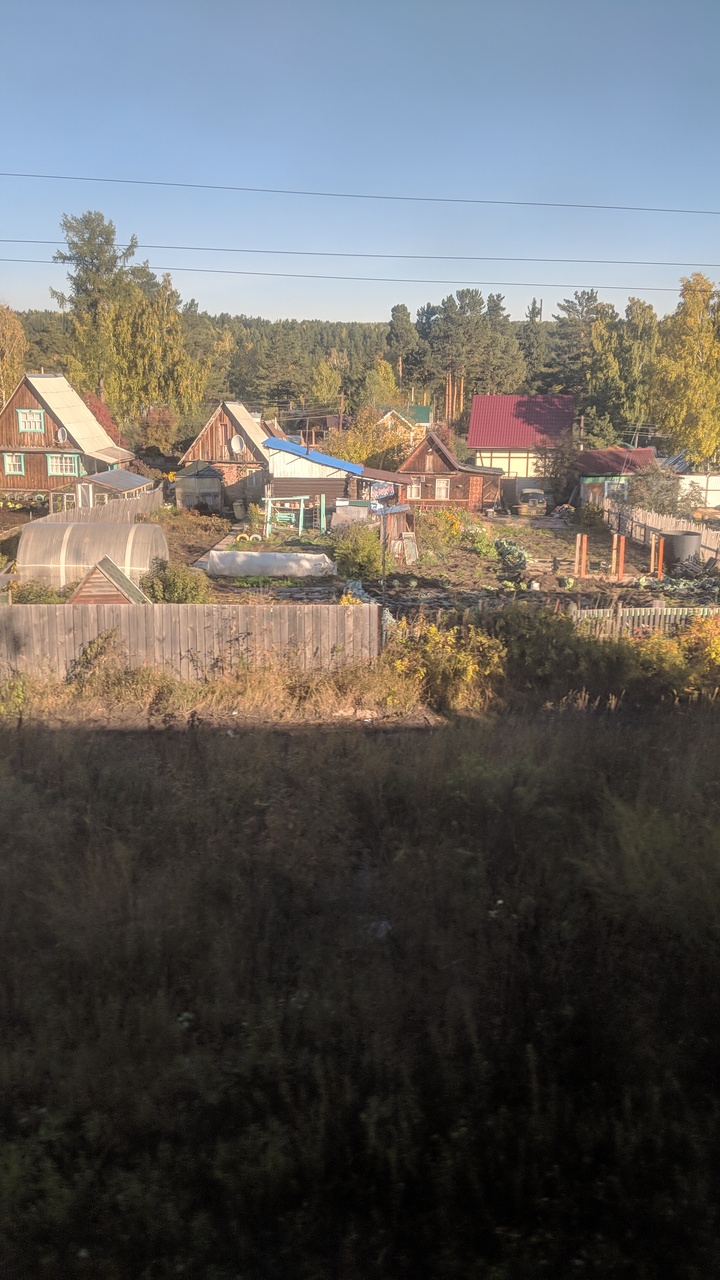
Three days on the train was a lot, but I was well served by my fondness for watching trees go by. As we moved further west, the tiny wooden towns became more frequent, and the outskirts of the bigger cities were also filled with little wooden “dachas” or summer houses, which I found endlessly delightful. The green, blue, and white motif that so dominated Siberia continued. Blue, I was told, is for luck, and green is for life.
When I finally made it to Moscow, I found it to be clean, bustling, and surprisingly walkable. Everyone seemed prosperous, and there were a lot of Russian tourists. I liked it, but was content with just three nights.
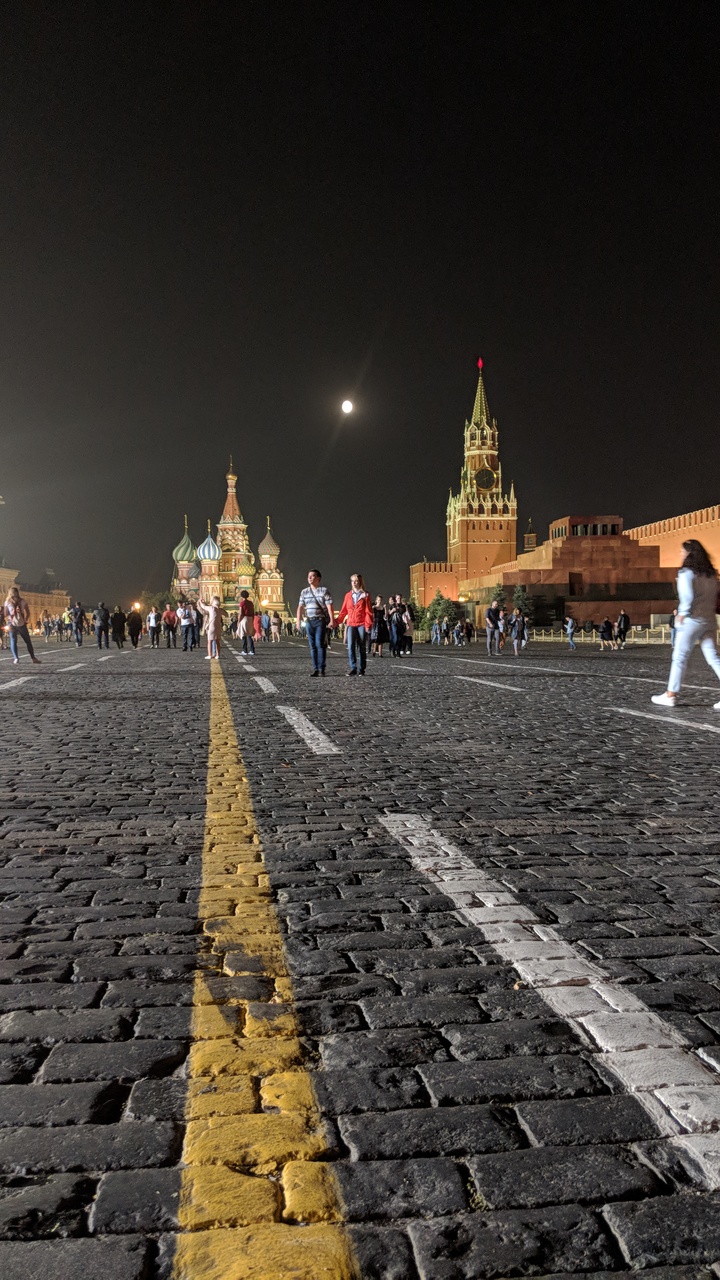
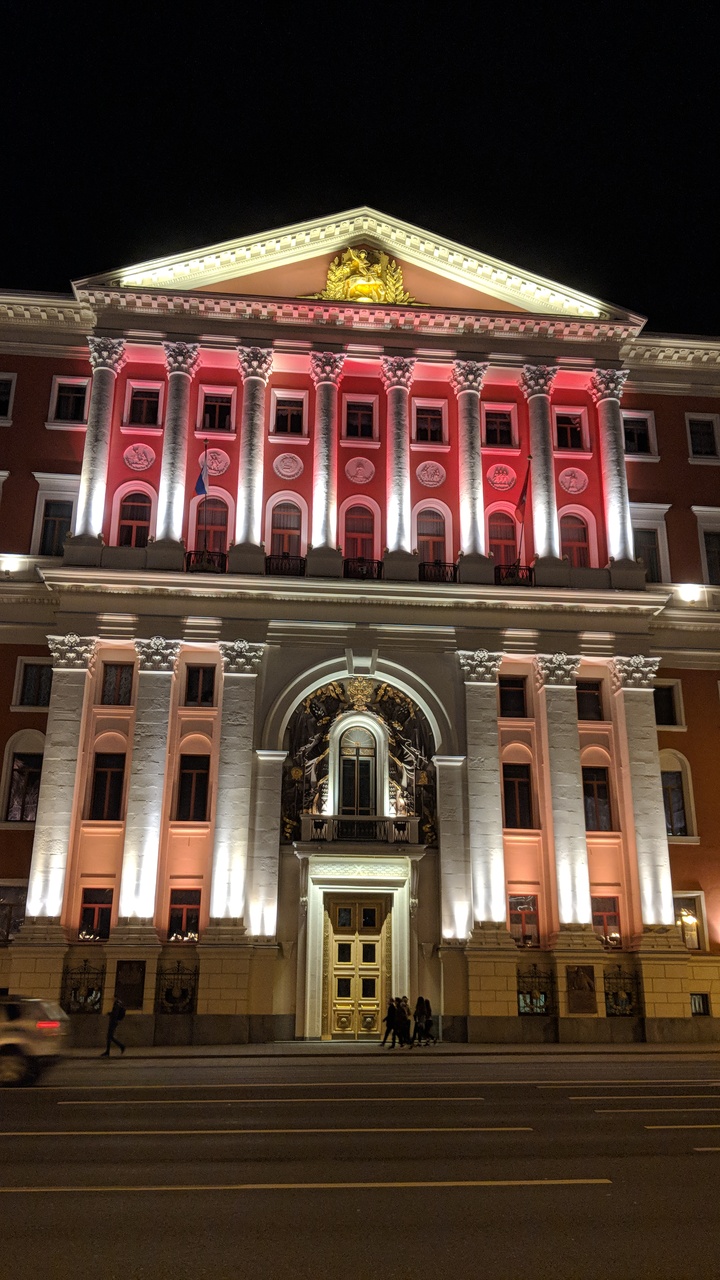
Technically, my Trans-Siberian journey was over (as was the package deal I’d bought to simplify planning everything). But I determined that it’d be both easier and more interesting to swing north through St Petersburg and Scandinavia than to go through Latvia, Lithuania, and Poland, which are poorly connected by rail.
St Petersburg left me with the impression of size — huge boulevards, huge buildings— and a latent beauty that I just didn’t catch in the right moment or light. Mostly, I was just cold and wet.
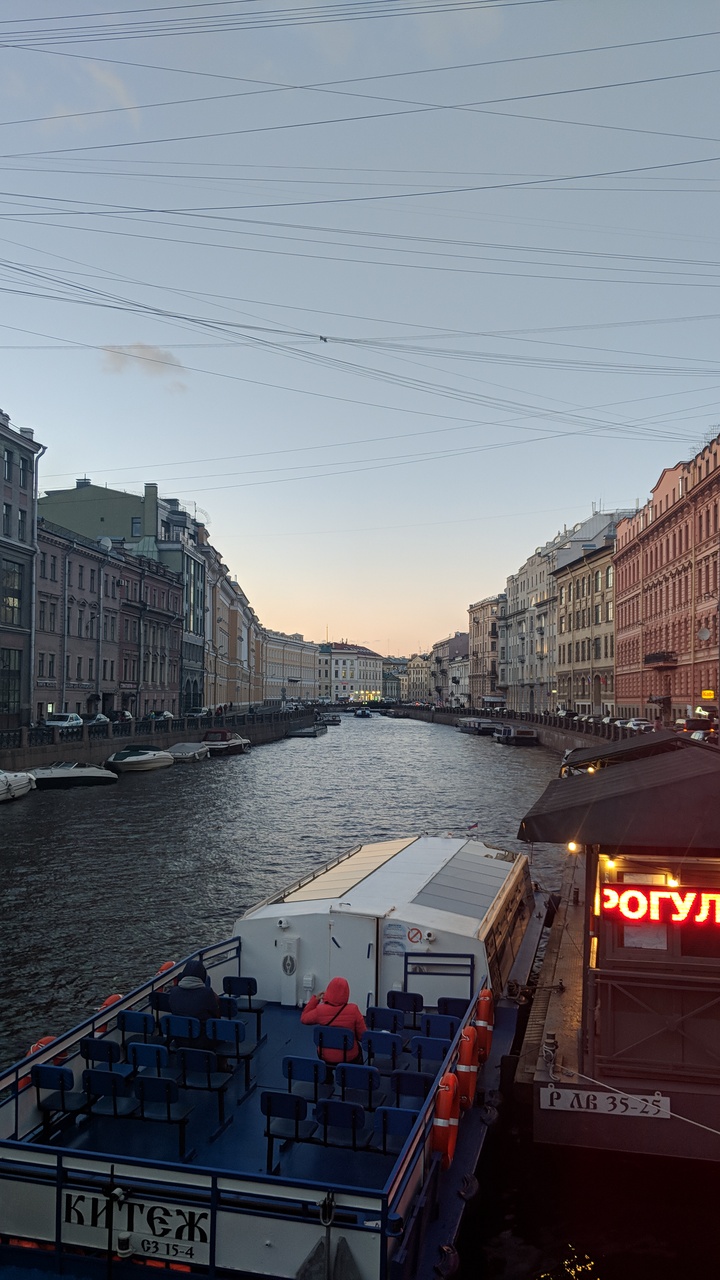
I spent just two nights there, really just enough time to see the Hermitage museum, which I’d always wanted to do. When I traveled in Europe as a teenage art history nerd, I was entranced by museums like the Hermitage — which is considered one of the world’s premiere art collections, on par with the Louvre, the Met, and the Prado — and spent long, contented hours just being in the presence of Renaissance masterworks.
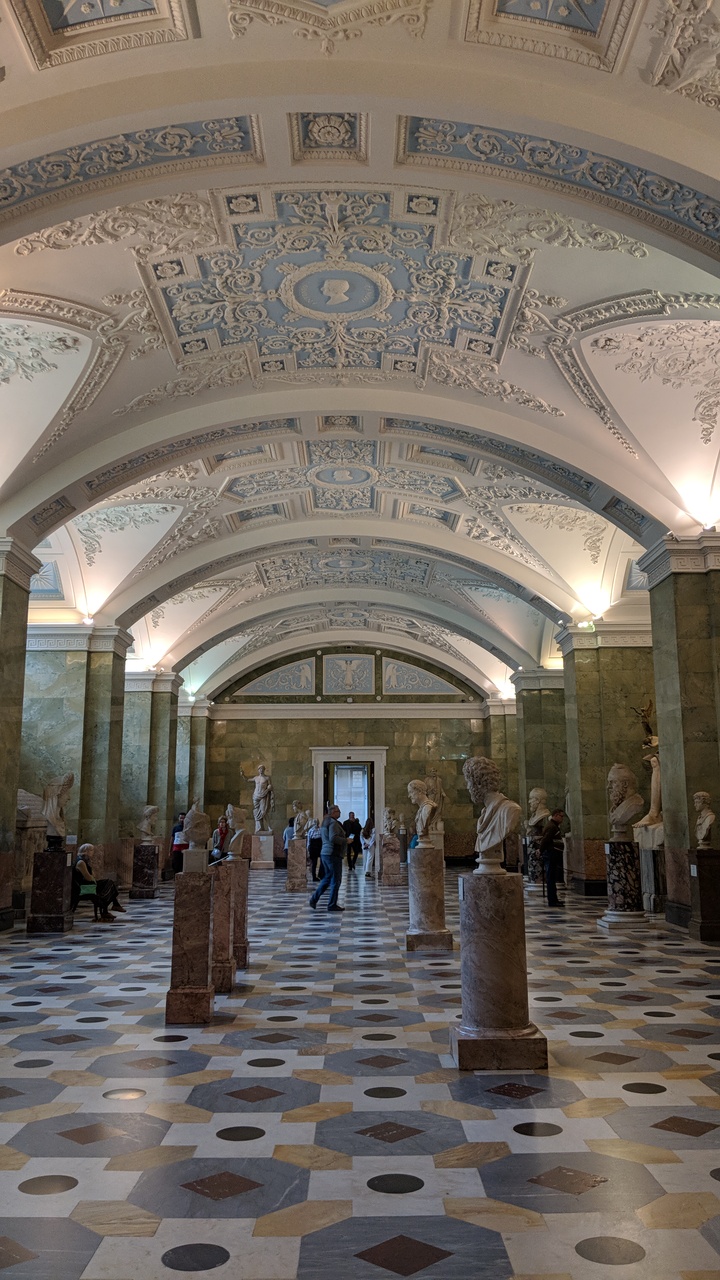
This time around, I found myself a bit less enthralled. I was a little surprised (but just a little) that some of the shine had come off: The Hermitage is an extremely impressive collection and a cool place to visit, but it was not, shall we say, transporting. In part, this is age. It’s just plain harder to be enthralled or transported in your mid thirties than as an adolescent. In part, it’s probably a political education, too: the trappings of old European wealth are less beautiful in the remembered context of colonialism and its many legacies.
But I realized, as I was walking through this temple of accumulation and history and artifact, that it’s also because the world just seems smaller now. When I was seventeen and saw Michelangelo’s David for the first time, that quasi-religious awe I felt was in part a function of what I perceived of as the vastness between my high school art history class in a little school on a little island in the middle of the Pacific, and the weighty significance of Florence. I felt that distance, and it thrilled me.
But I don’t feel the distance anymore. In fact, after this trip, I feel it now less than ever. I wondered, when I set out six and a half months ago, if covering this much actual ground would make the world seem bigger or smaller. Now I think I have my answer: The world feels (and is!) decidedly small. It feels small, fragile, in constant apocalyptic flux — and positively crowded with significance.
 Grounded