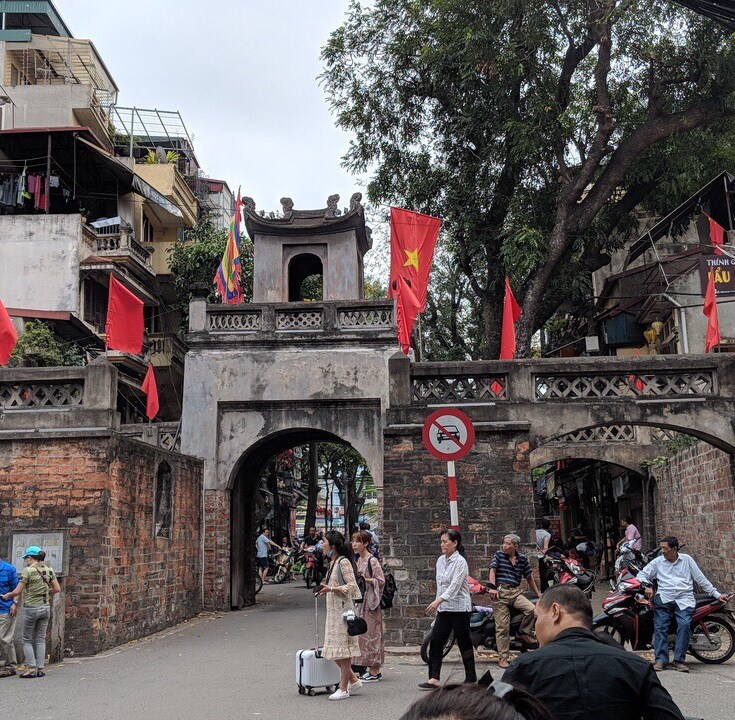

Have you seen the episode where Anthony Bourdain eats bún chả with Obama in Hanoi? You should. It’s good. (I’ve been watching bits of Parts Unknown on YouTube since Bourdain’s death, and I’m continually struck by how much his passing impressions resonate with my own, not to mention his lots-of-food-plus-dash-of-politics general approach.)
To quote: “Listen to me. Listen. To. Me. There is no other way to see this city, Hanoi, than from a motorbike.” He’s right, of course. Possibly my favorite moments in Vietnam were zipping along on the back of a bike, down dark, wet streets and wide boulevards, through churning, impossibly chaotic intersections and mad, dodging turns, chewing on exhaust and more than once afraid for my life.
I opted not to join the many tourists renting and driving bikes, though. (Let’s be real, people, traveling in Asia is actually not the best time to drive a motorbike for the first time.) Instead, I went with Grab — Vietnam’s Uber for motorbike taxis. Dirt cheap, no haggling, great fun… even when your driver keeps up a steady text message correspondence at 30mph in heavy, weaving traffic.
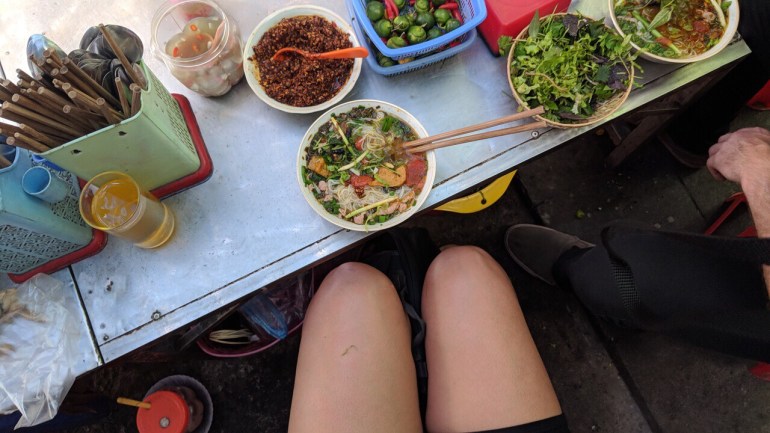
Hanoi is delicious chaos. The old quarter is a warren of tall, narrow old buildings — some of them crumbling picturesquely under the weight of ancient banyan trees — threaded with narrow streets that buzz with movement and activity. It’s not a city with sights per se, but rather a place where the time is best whiled — and the more of said time spent eating, the better. Favorite food experiences: snail noodle soup in the mouth of an alleyway (ask me if you wanna know where; after a friend took me there, I spent a not-insignificant amount of time on google maps retracing our steps so I could find it again), egg coffee (the love child of a cappuccino and a custard), and a pho bo that made my face sweat for a solid afternoon. Supposedly people go see Ho Chi Min’s tomb, but I skipped it.
Hanoi was my home base for trips north to Sapa and south to Hoi An and Hue. I had complicated feelings about my time in Sapa, had a mediocre time in Hue, and loved Hoi An despite myself.
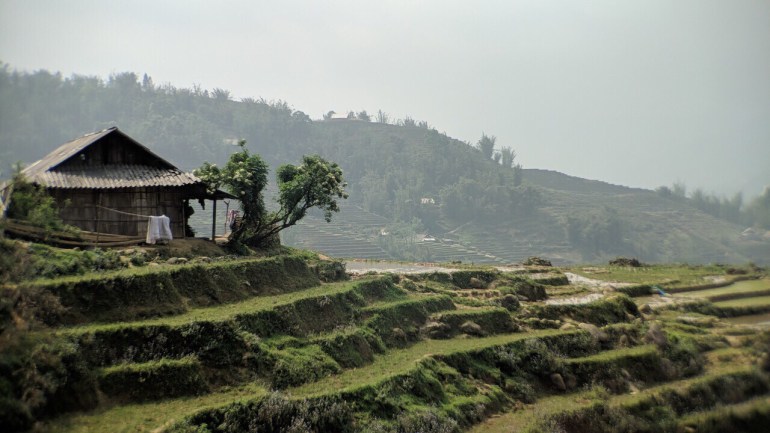
First off: Sapa is a formerly-sleepy, one-time hill station in the mountainous northwest that’s famous for iconic terraced rice paddies, ethnic minority villages, and trekking. No longer even remotely sleepy, the place is basically one big construction site now. (They’re even building an aerial tram to the top of nearby Mount Fansipan, the highest mountain in Vietnam.)
I spent a not-very-pleasant day and a night in Sapa while finding a good trekking outfit. I landed on Sapa O’Chau, a social enterprise that employs people from the nearby minority villages and uses the proceeds to build schools. We were a group of seven: a British couple, a Swiss couple, two French girls traveling together, and me. I was a solid 10-15 years older than everyone else. I hurt a lot. It was great.
We spent one night in a Black Hmong village and one night in a Tay village. There are eight distinct ethnic groups in the Muong Hoa river valley, each with their own language, traditions, dress, etc. They rarely intermarry and are largely segregated in separate villages, but they live peacefully alongside each other, farming rice in laboriously maintained paddies sculpted out of the steep hills. They’ve been there for hundreds of years, most having been pushed out of China generations ago. Both nights we spent there were homestays, where we ate with the family and then slept in an upstairs area set aside for that purpose. It was quite comfy.
The first night, we actually stayed with the family of our Hmong guide, Chi. She was lovely: vivacious, smart — she taught herself pretty impressive conversational English by just talking to tourists — and extremely hard working. She was also hands-down the person with whom I’ve had an actual substantive conversation with whose life has been most different from my own. She regaled us with the story of how she got married: at the age of 15, per the local custom, her now-husband kidnapped her, and his family held her captive for 3 days, until he took an offering of a chicken to her family to ask for her hand. I tried to get her to explain the “kidnapping” bit a little more to see how literal it was, and determined that the answer was quite literal. Chi mostly found this really funny. They’ve been married for 12 years. It’s just a little bit awkward, because the boyfriend that she had at the time of the kidnapping lives down the street.
One cultural difference that I wrestled with a lot the whole time I was in the area was the pretty pervasive practice of eating dogs. We saw one guy preparing a dead dog for butchering, and I’m pretty sure I heard a dog being killed in a village we were passing through. We seemed to be right on time for baby animal season too, so the place was positively teeming with puppies. I’ve never seen so many puppies in my life, and while normally this would elicit a lot of delight, it mostly broke my heart bit by bit.
When we finally got to Chi’s house that first night, I naively asked her what her dogs were called; she said she doesn’t name them, because she plans to eat them. It’s not my place to judge the food practices of people with a historically shaky access to protein. But no matter how much I liked my hosts or how much I told myself that my own dog-loving attitudes are socially constructed, it bothered me. I winced every time I heard a yelp. The constant tension sort of fried my nervous system, and by the time I left Sapa, I was glad to.
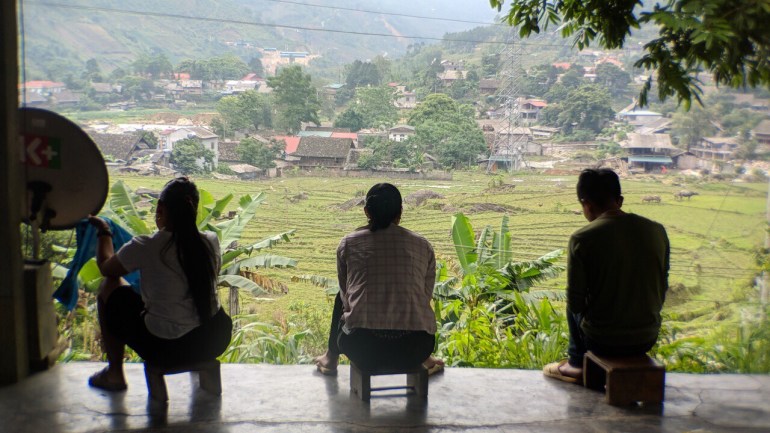
Still, I was impressed by the people. Chi can’t read or write, but she sends her two kids to school every day instead of having them work like she had to at their age. She wants them to be doctors or teachers. She proudly thinks of herself as Hmong. Vietnam and being Vietnamese are abstractions.
I asked Chi about the changes the area has seen over the past couple decades — wanting, honestly, to see if the local people felt any resentment about the recent development boom, which is mostly driven by outside investment, without a lot of local ownership or profit sharing. She talked about how they used to have to walk everywhere, even up into the high mountains to fetch wood for building houses. They’d walk for 12 hours each way. When the tourists started to come, people started to have a little bit of money, and about 12 years ago people started getting motorbikes. Now, almost every family has one. To state the obvious: hauling lumber on a motorbike is way easier than on your back. Chi was enthusiastically pro development, without caveat. Money is money, and every bit of it makes her relatively difficult life appreciably easier.
This pro-growth mindset seems pretty pervasive, and honestly it’s not hard to see why. Vietnam has only been free from war and colonization for a few decades, and it’s been open to trade with the rest of the world for even less than that. There’s a palpable sense of hustle in this country, like everyone’s trying to catch up on both the micro and macro scales.
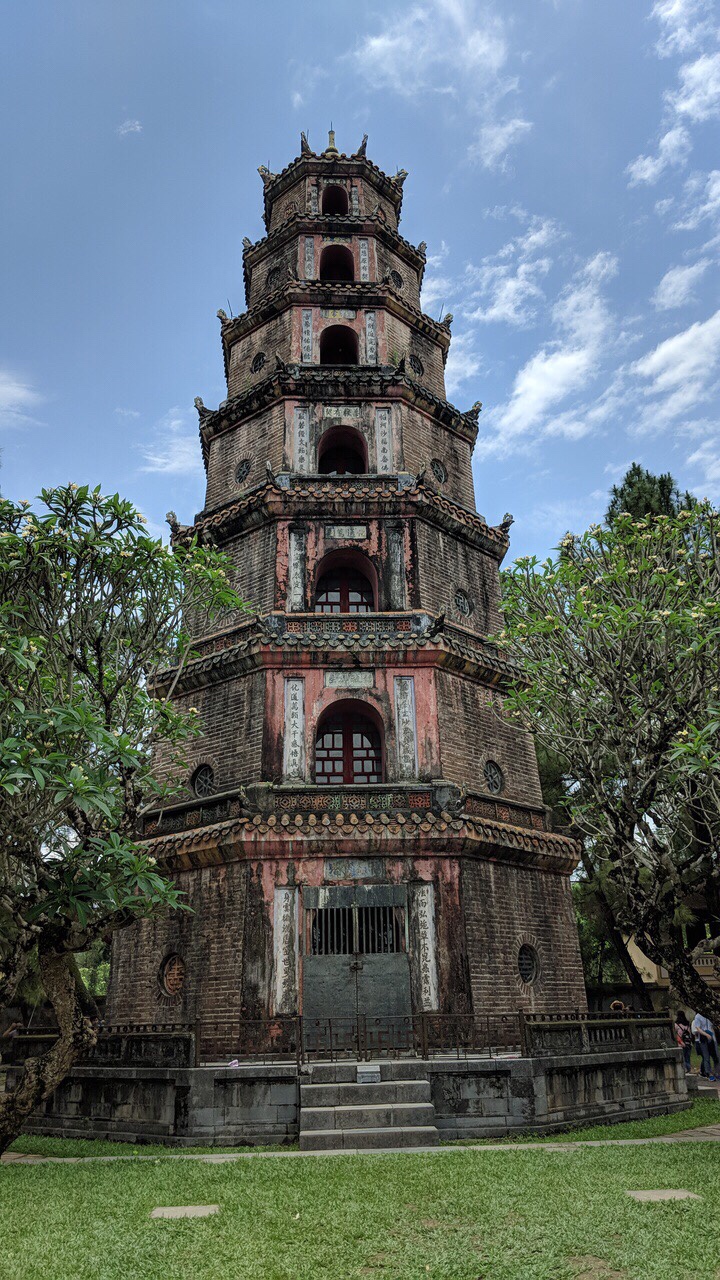
In Hue, I visited the old citadel and tombs of the Nguyễn emperors. As a visitor, Hue struck me as less a place to kick back and eat and more a place to check sights off a list. Whereas Hanoi’s old town seems dynamic and alive, Hue’s small tourist district felt stifling and artificial. It reminded me a bit of Waikiki. (Pro tip: don’t go on the big bus sightseeing tour, especially not the one your hotel tries to sell you. Yikes.)
One high point, though, was crossing the river to get a bowl of noodles with river clams from a little hole in the wall catering to locals, and another was admiring the stunning orchid and bonsai collections in the old citadel. I also enjoyed reading up on some of the fascinating history surrounding the Nguyễn dynasty, as my tour guide’s interpretations left something to be desired.
The Nguyễn clan ruled for not quite 150 years, starting in 1802. Their citadel was incredible, and the pleasure-gardens-cum-tombs that each emperor built for themselves along the Perfume River were lavish. But one thing I learned from my reading that wasn’t mentioned on any of the tours: despite their wealth and the fact that they had effectively “united” Vietnam, the Nguyễns’ dynastic reign was never really free from outside rule. In the 1800s, Vietnam was a vassal state of China, like many countries in the region. It then increasingly fell under the influence of French colonialism, until the country officially became a French protectorate in 1885, and the Nguyễn emperors became mere figureheads. Overall, the area now called Vietnam has spent very few years as an independent entity over the past millennium.
Thus, the hustle. Well, historic underdevelopment as a legacy of colonialism + decades of devastating war + years of authoritarian communism + a recent easing of at least some economic restrictions… thus, the hustle. To state the obvious: it’s complicated, and my own knowledge doesn’t run very deep here. But I’ve never been in a place where the sense of growth and change was so palpable — like it’s in the air, part of that unique smell.
The sheer number of enterprises in the country, from street food stands to fancy looking hotels, almost seems out of sync with the number of customers available, despite explosive growth in the number of visitors coming to Vietnam every year. I guess you only have to sell a couple of meals a day at tourist prices to make it worth it?
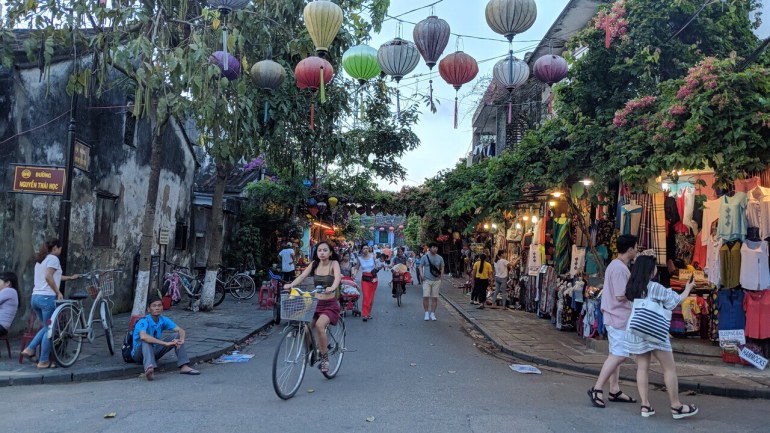
This seeming over-provisioning of tourist infrastructure was particularly notable in Hoi An. An exquisite little jewelbox of a tourist trap about halfway between Hanoi and Saigon, Hoi An is at the mouth of a river, which helped make it a world class trading port circa the 1500s. Nowadays, it’s a UNESCO World Heritage site and tourist catnip, thanks to its numerous streets of well-preserved Japanese shophouses and an abundance of vendors selling attractive paper lanterns, custom tailored clothing, and the regionally distinctive pork noodle salad. (I loved it for proximity to a really great beach, a couple of super blissful afternoons riding a bicycle through rice fields, and the best bahn mi of my trip.)
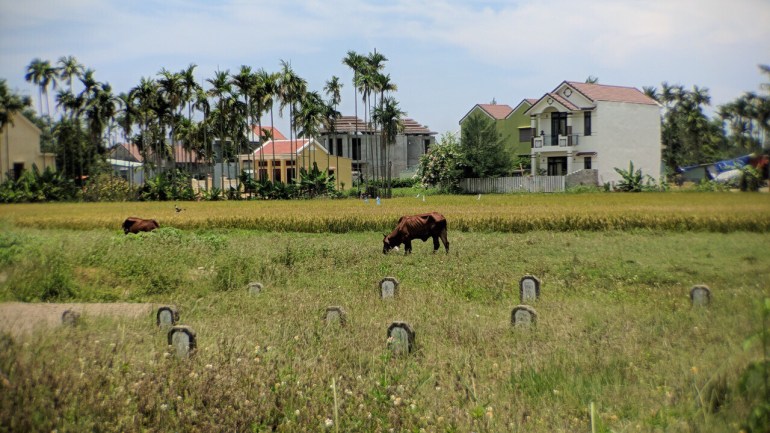
Between Hoi An and Danang, where I caught a train back up north to Hanoi, there’s a long strip of beachy coast. The visible buildings are few and far between, but both sides of the road for miles are lined with fences — and the fences are lined with splashy ads for the resorts and high-rises “coming soon.” In 5 years that stretch of coast is going to be unrecognizable, just as so many parts of the country are already unrecognizable from what they were two decades ago.
It’s clear that standards of living have gone up dramatically in Vietnam during this relatively recent period of (relatively limited) market liberalization. But from both what I observed and what I’ve read, life is still pretty hard as a rural rice farmer, and rural rice farmers are still the majority. Foreign and state-owned enterprises are reaping most of the rewards.
Meanwhile, coal is literally fueling this boom, and it’s slated to grow pretty massively in the coming decade, with the 3rd largest coal development program in the world after China & India. Coal is also a protected industry, controlled by a state-owned enterprise, with the profits flowing to party higher-ups.
I wonder about that strip of coastline outside Danang, and what will happen to those fancy high rise resorts when the seas start rising more rapidly. I think about the things all that development money might have been spent on.
To be honest — and I hope I don’t get banned from the country for life for writing this on the internet — Vietnam’s political-economics struck me as sort of the worst of both worlds. The “socialist-oriented market economy” that they’ve been building since the late 1980s has all the environmental ravages and expanding inequality of unchecked capitalism, but the profits all accrue to party bosses and loyalists. Plus, you’ve got that whole single-party state thing, repression of dissent, lack of free elections, lack of a free press, etc etc.
The place and the people and the culture are so remarkable, but the politics really aren’t pretty.
Notes for travelers
In general, Man in Seat 61’s recommendations and knowledge served me well in Vietnam, where I traveled mostly by train. For the train to Sapa I opted for the regular sleeper cars used by locals, which provided a perfectly acceptable experience (although the train was on the loud, rattle-y side). A shared taxi van from Lao Cai, where the train lets off, to Sapa, will take about an hour. I’m now forgetting how much I paid, but it was cheap — like less than $5 USD.
For the train to Hue, there were only berths on the tourist sleepers available. They’re like twice the price, and the main difference is slightly nicer bedding + likelihood of being bunked with locals vs other foreigners. Not worth it generally (although on the train back up north from Danang to Hanoi, I was alone in a berth with an old man who kept chatting incessantly in Vietnamese, despite my obvious inability to understand him).
Food and beverage service seems to be pretty inconsistent across both classes of trains, so if you’re a coffee addict like me, plan ahead and bring something in a can. Or, even better, get some of that excellent instant coffee available in Vietnam and avail yourself of the hot water stations that were on all the trains I traveled on.
I also took sleeper buses both on my return trip from Sapa and from Hue to Hoi An. These are typically arranged with three rows of two levels of “seats”, which are a sort of combination between a bunk and a permanently reclined chair. I found them pretty uncomfortable, especially on long hauls. They don’t tend to have restrooms, but will stop for breaks and food at somewhat inconsistent intervals. Be prepared to take your shoes off when you get on and off.
 Grounded